
Views: 0 Author: Site Editor Publish Time: 2026-09-14 Origin: Site


Specifying the wrong fastener in high-pressure piping introduces massive risk. A flanged joint acts as a dynamic assembly where the fastener functions as a heavy-duty spring. If that spring yields, relaxes, or fractures under thermal cycling or pressure spikes, you lose clamping force. This leads directly to hazardous leaks, unplanned downtime, and severe safety incidents. The engineering challenge involves navigating overlapping ASME dimensional standards, ASTM material specifications, and thread pitch requirements to match precise environmental demands.
Selecting the correct stud bolt requires moving beyond basic diameter and length measurements. You must evaluate the exact interaction between the flange face, the gasket material, the operating temperature, and the corrosive nature of the surrounding environment. By applying industry standards systematically, project teams ensure compliance, maintain joint integrity, and maximize operational longevity in heavy infrastructure.
Dimensional Compliance: ASME B16.5 and B16.47 dictate the exact diameter and length requirements for flange connections, requiring precise effective thread length calculations.
Material Baselines: The combination of ASTM A193 (e.g., Grade B7) studs with ASTM A194 (Grade 2H) nuts serves as the industry standard for high-pressure, high-temperature carbon and alloy steel flanges.
Thread Pitch Rules: Transitioning from Unified Coarse (UNC) to the 8-Thread Series (8UN) at the 1-1/8" diameter threshold is non-negotiable for proper load distribution.
Strength vs. Environment: Specifying a High Strength Stud Bolt requires a calculated trade-off between maximum tensile strength and vulnerability to environmental factors like hydrogen embrittlement.
Establishing baseline operational requirements must precede any review of specific engineering standards. A fastener does not operate in isolation. Its primary function is to generate and maintain sufficient compressive load on a gasket to seal a joint against internal pressure. Failing to define the exact mechanical and environmental stresses the joint will face guarantees premature failure. You must first quantify the maximum internal pressure, the peak operating temperature, and the external environmental conditions before selecting a material grade or dimensional profile.
The required clamping force dictates the size and material of the fastener, and this force is heavily influenced by the gasket type. Different gaskets require vastly different seating stresses. A soft elastomeric flat face gasket requires minimal load to achieve a seal. In contrast, a spiral wound gasket with a metal centering ring or a solid metal Ring Type Joint (RTJ) demands massive initial compression to yield the metal into the flange grooves.
Gasket Type | Relative Seating Stress Required | Impact on Fastener Selection |
|---|---|---|
Elastomeric / Rubber (Flat Face) | Low | Standard carbon steel often sufficient; avoid over-torquing to prevent gasket crush. |
Spiral Wound (with Centering Ring) | High | Requires high-yield alloy steel (e.g., B7) to achieve proper compression of the winding. |
Ring Type Joint (RTJ) | Very High | Demands maximum tensile strength to coin the metal ring into the flange groove. |
Corrugated Metal | Medium to High | Requires consistent, even tensioning across all fasteners to prevent localized leaks. |
Furthermore, the uncompressed thickness of the gasket directly alters the required length of the fastener. If the calculation ignores gasket thickness, the installed fastener will lack sufficient thread protrusion to fully engage the heavy hex nut, violating basic assembly codes.
Operating conditions determine the minimum yield strength and thermal expansion limits of the fastener. When a pipe system is pressurized, hydrostatic end force attempts to push the flanges apart. The fasteners must possess enough tensile strength to resist this force while maintaining residual load on the gasket. Temperature introduces another variable. As temperatures rise, steel expands and its yield strength drops. If the fastener expands at a faster rate than the flange material, the joint loses clamping force and leaks. Conversely, if the flange expands faster than the fastener, the bolt stretches beyond its yield point, permanently deforming it. Matching the coefficient of thermal expansion between the flange and the fastener is mandatory for high-temperature service.
Material degradation from environmental exposure rapidly compromises joint integrity. Industrial environments expose fasteners to chemical spills, offshore salinity, and extreme weather. Standard carbon steel rusts, leading to thread seizing and structural weakening. To combat this, you must specify appropriate protective barriers.
Hot-dip galvanizing provides a thick sacrificial zinc layer for general outdoor exposure, though it requires oversized nuts to accommodate the coating thickness.
PTFE (Polytetrafluoroethylene) coatings offer exceptional chemical resistance and low friction for easier disassembly in petrochemical plants.
Zinc-nickel plating delivers high corrosion resistance in salt-spray environments without the heavy thickness of galvanizing, making it ideal for offshore platforms.
Cadmium plating remains utilized in specific aerospace and military applications for its lubricity and galvanic compatibility with aluminum, despite toxicity restrictions in some regions.
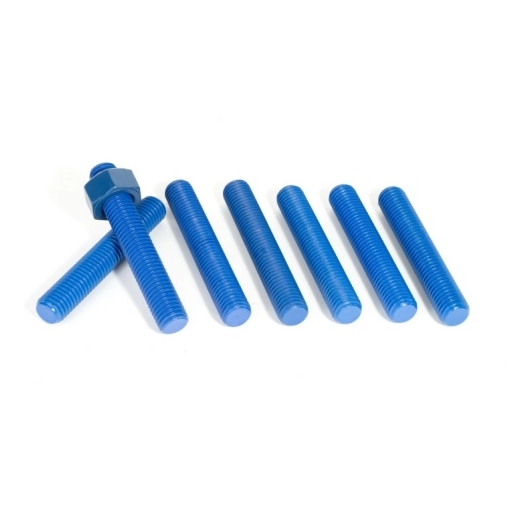
Continuous threading represents the industry standard for flanged joints in piping systems. These fasteners feature threads running their entire length, allowing nuts to be threaded from either end. This design permits equal distribution of tension and maximum nut engagement. Fully threaded variants are highly versatile, accommodating slight variations in flange thickness or gasket compression. In high-pressure applications, the uniform cross-section of a fully threaded body ensures that stress distributes evenly along the length of the fastener, preventing localized stress concentrations that cause fatigue failure.
Tap-end configurations feature a short thread on one end, an unthreaded shank in the middle, and a longer thread on the opposite end. The short end is machined with an interference fit (often a Class 3 thread fit) designed to be permanently driven into a tapped hole in a heavy machinery housing or a blind flange. The longer end accepts a standard nut for clamping the mating component. These are strictly required in AWHEM (Association of Well Head Equipment Manufacturers) specifications and are heavily utilized in blowout preventers, engine blocks, and heavy pump casings where passing a bolt entirely through the housing is impossible.
Double-end designs feature equal lengths of threading on both ends, separated by an unthreaded central shank. The unthreaded shank is typically equal to the major diameter of the thread. We utilize these in specialized high-strength applications where equal thread length on both ends is required, but full threading is unnecessary and potentially detrimental. In some high-performance applications, the central shank is reduced to the minor diameter of the threads. This creates a stretch bolt that absorbs shock loads and thermal expansion more effectively than a rigid, fully threaded body, maintaining consistent clamping force under dynamic conditions.
The American Society of Mechanical Engineers (ASME) dictates the exact dimensional requirements for pipe flanges and flanged fittings, which in turn dictates fastener sizing. ASME B16.5 covers flanges from 1/2 inch through 24 inches in nominal pipe size (NPS). It provides standardized bolt circle diameters, hole sizes, and fastener lengths for various pressure classes (Class 150 through Class 2500). For large diameter piping, ASME B16.47 takes over, covering NPS 26 through NPS 60. B16.47 is further divided into Series A (thicker, heavier flanges for general pipeline use) and Series B (thinner, lighter flanges often used in compact piping systems). Selecting the correct fastener length requires cross-referencing the specific ASME standard, the NPS, and the pressure class.
A frequent error in fastener procurement is measuring length incorrectly. ASME standards define the length of a flanged joint fastener by its effective thread length. This measurement is taken parallel to the axis, from the first full thread on one end to the first full thread on the opposite end. It explicitly excludes the chamfered or rounded ends. If a procurement team orders based on end-to-end overall length rather than effective thread length, the resulting fastener will be too short. This leads to insufficient nut engagement, where the threads do not fully protrude through the heavy hex nut, violating structural codes and severely reducing the load-bearing capacity of the joint.
To calculate the correct length manually, follow these steps:
Measure the exact thickness of both mating flanges.
Add the uncompressed thickness of the specified gasket.
Add the height of two compatible heavy hex nuts.
Add the length of at least two full threads for protrusion on each end of the assembly.
Flange class ratings exponentially alter the required dimensions. A 4-inch Class 150 flange requires a vastly different fastening solution than a 4-inch Class 2500 flange. As the pressure class increases, the flange thickness increases to withstand the internal forces. Consequently, the fasteners must increase in both diameter and length. A Class 150 joint might require eight 5/8-inch diameter fasteners, while the exact same pipe size in a Class 2500 system might require eight 1-1/2-inch diameter fasteners. You must verify the pressure class on the piping and instrumentation diagram (P&ID) before referencing the ASME dimensional tables.
ASTM A193 is the definitive specification for alloy steel and stainless steel bolting materials for high-temperature or high-pressure service. Within this standard, specific grades dictate the chemical composition and mechanical properties.
Grade B7: The most common grade for industrial applications. Manufactured from chromium-molybdenum steel, quenched and tempered for high strength. Suitable for temperatures up to 400°C (750°F).
Grade B7M: Similar to B7 but undergoes a specialized heat treatment to reduce its yield strength and hardness. This makes it resistant to sulfide stress cracking, rendering it mandatory for sour gas (hydrogen sulfide) environments per NACE MR0175.
Grade B16: Contains vanadium, allowing it to maintain its structural integrity and resist relaxation at higher temperatures than B7, typically up to 593°C (1100°F). Common in power generation and steam lines.
Grade B8/B8M: Austenitic stainless steel grades (304 and 316 respectively) used in highly corrosive environments where carbon steel would rapidly degrade.
Standard carbon and alloy steels become brittle at sub-zero temperatures, losing their impact toughness and becoming susceptible to sudden, catastrophic failure under load. ASTM A320 covers materials specifically engineered for cryogenic and low-temperature service. Grade L7 is the standard choice for temperatures down to -101°C (-150°F). Like B7, it is a chromium-molybdenum alloy, but it undergoes rigorous Charpy V-notch impact testing at low temperatures to guarantee its ductility. For low-temperature sour gas applications, Grade L7M is specified, offering the same sulfide stress cracking resistance as B7M but with certified low-temperature toughness.
Matching the fastener material with the flange material is critical to prevent two specific failure modes: galvanic corrosion and differential thermal expansion. If carbon steel fasteners are used on a stainless steel flange in a wet environment, the carbon steel acts as an anode and corrodes rapidly to protect the stainless steel cathode. Furthermore, austenitic stainless steel has a much higher coefficient of thermal expansion than carbon steel. If carbon steel fasteners are used on a stainless flange in a high-temperature application, the flange will expand more than the fasteners, stretching them beyond their yield point and causing the joint to leak upon cooling.
A high-strength fastener is useless if paired with a weak nut. The threads of the nut must be strong enough to withstand the load applied by the bolt without stripping. ASTM A194 specifies the heavy hex nuts required for high-pressure and high-temperature service. The standard rule is that the nut must be slightly softer than the bolt to prevent thread galling, but strong enough to carry the full tensile load.
Stud Bolt Grade (ASTM A193/A320) | Material Description | Compatible Heavy Hex Nut (ASTM A194) | Typical Application |
|---|---|---|---|
A193 Grade B7 | Chromium-Molybdenum Steel | Grade 2H | Standard High-Pressure / High-Temp |
A193 Grade B7M | Modified Cr-Mo (Lower Hardness) | Grade 2HM | Sour Gas / NACE Compliance |
A193 Grade B16 | Cr-Mo-Vanadium Steel | Grade 4 or Grade 7 | Extreme High Temperature (Steam) |
A320 Grade L7 | Cr-Mo Steel (Impact Tested) | Grade 4 or Grade 7 | Cryogenic / Low Temperature |
A193 Grade B8M (Class 1) | 316 Stainless Steel | Grade 8M | Corrosive Environments |
Thread pitch dictates the mechanical advantage during tightening and the strength of the engaged threads. Unified National Coarse (UNC) is the default standard for general industrial applications. Coarse threads assemble quickly, resist cross-threading, and provide adequate clearance for thick protective coatings like hot-dip galvanizing. Unified National Fine (UNF) threads have a larger minor diameter, providing a slightly larger tensile stress area and better resistance to vibration-induced loosening. However, UNF threads are easily damaged and prone to cross-threading in heavy industrial field conditions. Metric threads (M-series) operate on similar principles but are specified globally outside of North American legacy systems, requiring careful attention to avoid mixing metric and imperial components on the same site.
As fastener diameters increase, standard UNC thread pitches become progressively coarser. A 1-1/2 inch UNC fastener has only 6 threads per inch. This deep thread profile significantly reduces the minor diameter (the solid core of the fastener), thereby reducing its cross-sectional area and overall tensile strength. To solve this, the oil and gas industry, mandated by AWHEM and ASME standards, utilizes the 8-Thread Series (8UN). The rule is strict: sizes 1 inch in diameter and below utilize standard UNC threads. Sizes 1-1/8 inch and above must transition to 8UN threads. This means regardless of how large the diameter gets, there are always exactly 8 threads per inch. This preserves the root area of the fastener, maximizes load-bearing capacity, and provides finer control over tensioning during installation.
Specifying a High Strength Stud Bolt requires understanding the relationship between yield strength and tensile strength. Yield strength is the point at which the material permanently deforms. Tensile strength is the point at which it breaks. High-strength alloys offer massive yield strengths, allowing for extreme clamping forces on heavy-duty flanges. However, this strength comes at the cost of ductility. As hardness increases, the material becomes more brittle. You must evaluate whether the joint requires maximum clamping force or if it needs the ability to flex and absorb dynamic loads without snapping.
In applications subjected to cyclical loading, vibration, or severe thermal cycling, fatigue resistance becomes more critical than static tensile strength. High-strength variants perform well under static loads but can be susceptible to fatigue failure if surface imperfections act as stress risers. To improve fatigue life, threads on high-performance fasteners are often rolled rather than cut. Thread rolling compresses the grain structure of the steel, creating a smoother surface and inducing compressive residual stresses at the thread root, which significantly delays the onset of fatigue cracking.
The greatest hidden risk when utilizing high-strength steel (typically any fastener with a hardness above 39 HRC) is hydrogen embrittlement. During manufacturing processes like acid pickling or electroplating, atomic hydrogen can diffuse into the steel matrix. Under tensile stress, these hydrogen atoms migrate to areas of high stress concentration, causing sudden, delayed, and catastrophic brittle fracture. To mitigate this, high-strength fasteners that undergo electroplating must be subjected to a strict post-plating baking process within hours of coating to drive the hydrogen out of the steel.
Thread galling, or cold-welding, is a severe problem during installation, particularly with austenitic stainless steel fasteners or when using fasteners of the exact same hardness as the nut. Friction during tightening causes localized heat, breaking down the protective oxide layer and causing the metal surfaces to fuse. Once galled, the fastener cannot be tightened or loosened and must be cut off. Mitigation requires mandating the use of heavy-duty anti-seize lubricants containing molybdenum disulfide, copper, or nickel. Alternatively, factory-applied baked-on coatings like PTFE eliminate the need for wet lubricants and prevent galling entirely.
Applying the correct load is just as critical as selecting the correct material. Traditional torque wrenching is notoriously inaccurate, as up to 90% of the applied energy is consumed by friction under the nut face and within the threads, leaving only 10% to actually stretch the bolt. For critical high-pressure flanges, hydraulic tensioning is required.
Thread the hydraulic tensioner puller onto the stud protruding above the nut.
Apply hydraulic pressure to physically stretch the fastener to the exact required load.
Spin the heavy hex nut down tight against the flange face by hand.
Release the hydraulic pressure, transferring the load directly to the nut and flange.
The global supply chain is vulnerable to substandard and counterfeit fasteners that display forged head markings. Installing a counterfeit fastener in a high-pressure system guarantees failure. Traceability is the only defense. Procurement teams must require comprehensive Mill Test Reports (MTRs) from vetted suppliers for every batch of fasteners. The MTR must verify the exact chemical composition, the heat treatment process, and the mechanical properties to ensure absolute compliance with the specified ASTM standard.
Cross-reference your piping and instrumentation diagrams (P&ID) with ASME B16.5 or B16.47 tables to verify exact pressure classes and required effective thread lengths before generating a bill of materials.
Demand fully traceable Mill Test Reports (MTRs) from suppliers prior to accepting delivery of any critical bolting materials to verify chemical composition and yield strength.
Establish and document strict hydraulic tensioning procedures, including mandatory lubrication protocols, for the assembly crew to prevent thread galling and uneven flange loading.
Audit field installations to ensure correct thread protrusion, verifying that at least two full threads extend beyond the heavy hex nuts across all flanged connections.
A: A hex bolt has a forged head on one end and threads on the other, requiring a single nut. A stud is a cylindrical rod threaded on both ends or along its entire length, requiring two nuts. Studs are preferred in heavy flanges because they distribute tension more evenly and are easier to align during assembly.
A: Fully threaded variants have continuous threads from end to end. Tap-end variants have a short interference-fit thread on one end for screwing into a tapped hole, and a longer thread for a nut on the other. Double-end variants have equal thread lengths on both ends separated by an unthreaded central shank.
A: The calculation must include the thickness of both mating flanges, the uncompressed thickness of the selected gasket, the height of two heavy hex nuts, and enough extra length to ensure at least two full threads protrude beyond each nut after final tightening.
A: Specify high-strength variants when extreme internal pressures or massive flange sizes demand clamping forces that exceed the yield strength of standard Grade B7. However, you must account for the reduced ductility and increased risk of hydrogen embrittlement associated with higher hardness materials.
A: If standard UNC threads were used on large diameters, the threads would be too deep, significantly reducing the minor diameter and the cross-sectional area of the fastener. The 8UN standard maintains 8 threads per inch, preserving the core thickness and maximizing tensile strength.
A: No. Mixing grades creates uneven clamping forces and unpredictable thermal expansion rates. You must use identical grades for all fasteners on a single flange and pair them strictly with their designated compatible nuts to maintain joint integrity.


