
Views: 0 Author: Site Editor Publish Time: 2026-10-16 Origin: Site


Picture a technician deep inside a ship bulkhead, wrestling with a standard wrench that simply will not turn due to a severe lack of clearance. Standard tools routinely fail in these confined industrial arenas. This leads to costly delays and compromised safety. A specialized fastening component solves this exact mechanical frustration. In this comprehensive guide, you will learn the core engineering purposes of this hardware. We will dive into its physical anatomy, explore high-stakes industrial applications, and provide actionable advice on specifying the correct components for extreme environments.
Targeted Leverage: This hardware utilizes side-drilled radial holes and a solid cylindrical rod to deliver high-torque tightening in narrow spaces where conventional sockets cannot operate.
Extreme Environment Ready: Often treated with advanced finishes, such as fluorocarbon coatings, these fasteners offer maximum anti-corrosion protection for the oil, gas, and marine sectors.
Versatile Designs: While many variations are initially designed to be spun by hand for rapid assembly, they can be locked down securely with a bar, offering unique spatial advantages over traditional hex profiles.
Enhanced Operational Reliability: Engineered specifically to maintain structural clamping force under aggressive chemical exposure, high-temperature fluctuations, and heavy mechanical vibrations.
To fully grasp the practical applications of this hardware, we must first examine its physical characteristics and primary engineering purpose. This component is a highly specialized fastener designed specifically to overcome the spatial limitations of traditional hex-driven tightening methods.
The physical geometry of a tommy bar hole nut is distinctly different from standard off-the-shelf hardware. It typically features a round or modified hex body. Instead of relying exclusively on flat outer edges for a wrench to grip, its defining characteristic is a series of radial holes precision-drilled directly into the outside diameter.
These machined holes accommodate the mating tool known as the tommy bar. This tool is a solid, hardened cylindrical steel rod. When an operator inserts the rod into one of the radial holes, it immediately acts as a mechanical lever. By applying perpendicular force to the end of the bar, the technician generates immense torque to secure or loosen the joint. Consequently, this design shifts the tool required operating space from the wide exterior perimeter to a single, direct line of leverage.
Component | Description | Primary Engineering Function |
|---|---|---|
Nut Body | Round or modified hex shape with internal threading. | Provides the primary clamping force along the threaded shaft. |
Radial Holes | Blind or through-holes drilled into the outer diameter. | Acts as the precise insertion point for the leverage tool. |
Tommy Bar | A solid, cylindrical hardened steel rod. | Serves as a lever to apply high-torque rotational force without a bulky wrench. |
The terminology surrounding this tool has roots in early mechanical engineering and military history. Field mechanics desperately needed robust, uncomplicated tools to adjust heavy artillery and field lathes in muddy, cramped conditions. Over the decades, this highly practical field design transitioned into a standardized, rigorously tested solution for modern heavy industry.
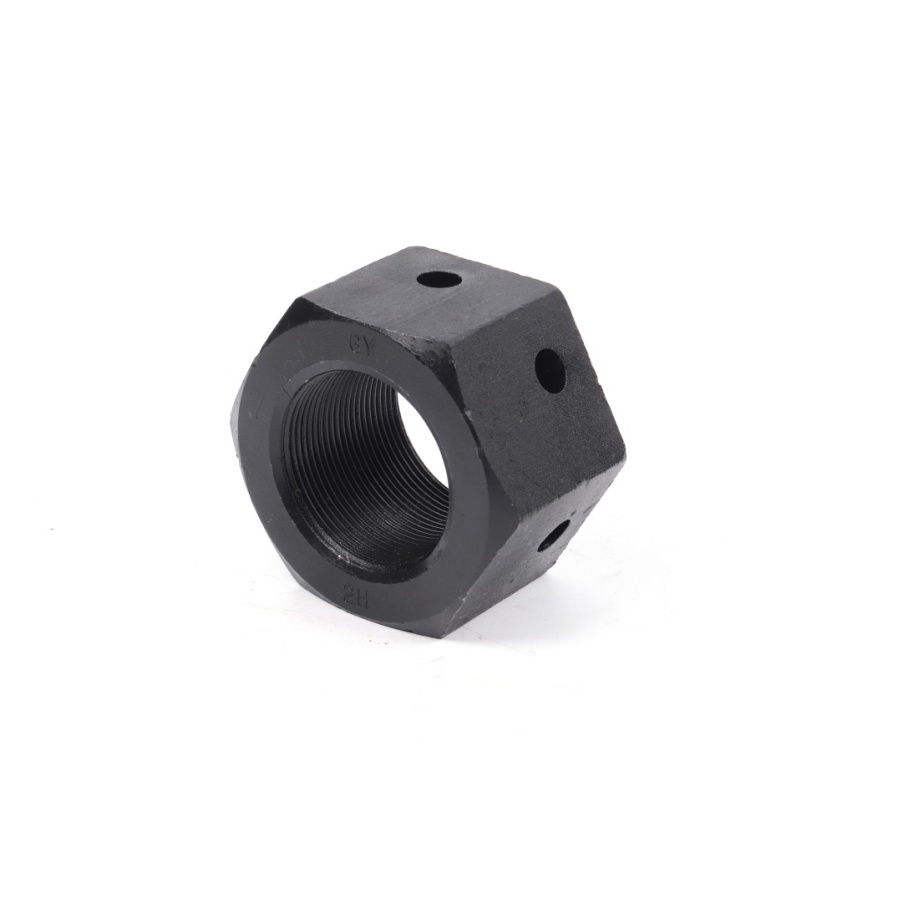
The true mechanical advantage of this fastener lies in its streamlined installation workflow. It is purpose-built to simplify the assembly process on the factory floor while guaranteeing a secure, vibration-resistant lockdown.
Installing this hardware generally follows a highly efficient two-phase workflow. During the initial phase, the technician threads the component onto the mating bolt or stud. Many premium designs feature a knurled outer edge or a smooth, ergonomic profile that is easily hand tightenable. This specific feature allows workers wearing grease-covered gloves to rapidly spin the hardware down the threaded shaft, saving critical labor minutes during large-scale assemblies.
Once the component is seated firmly against the mating surface, the second phase begins. The operator slides the cylindrical bar into the most accessible radial hole. Applying steady force to the bar achieves the final, high-leverage torque required to lock the joint securely. Ultimately, this two-step process perfectly bridges the gap between assembly speed and long-term structural security.
We can evaluate the primary engineering value of this mechanism using a standard Feature-Advantage-Benefit framework.
Feature: Precision-machined, side-drilled radial holes.
Advantage: The tightening mechanism requires minimal radial clearance. A standard wrench demands a wide arc of open space to turn, while a socket requires significant vertical clearance. In contrast, the bar method only needs a narrow channel of space for insertion and leverage.
Benefit: This drastically simplifies installation and routine maintenance in notoriously confined areas, such as recessed ship bulkheads or densely packed turbine housings, reducing both downtime and injury risks.
Recently, there has been a noticeable shift in heavy industry toward more compact, densely packed equipment designs. The global push towards ultra-deepwater drilling and modular plant architecture has drastically reduced available maintenance envelopes. Engineers are noticing a critical trend where traditional flange connections are being squeezed into tighter spatial footprints to save weight and material costs. This miniaturization demands fastening solutions that can deliver massive clamping forces without requiring bulky hydraulic torque wrenches. Consequently, bar-driven fasteners are transitioning from niche problem-solvers to baseline specifications in front-end engineering design.
In the high-stakes oil and gas industry, critical equipment such as blowout preventers, wellheads, and pipeline flanges are frequently situated in highly restricted spatial envelopes. Bar-driven hardware is heavily relied upon in these unforgiving environments. When assembling complex pipeline infrastructure, technicians routinely encounter situations where adjacent pipes or structural steel supports physically block the use of hydraulic torque wrenches. The perpendicular bar design allows crews to secure vital joints safely and accurately. Furthermore, these components are forged from high-yield alloys, ensuring they maintain absolute structural integrity under the immense internal pressures characteristic of deep-water extraction.
Shipbuilding and offshore platforms present engineers with a brutal dual challenge. They must navigate the cramped architecture of a submarine compartment while fighting relentless environmental degradation. Saltwater corrosion acts as a constant, aggressive threat to structural integrity. Fasteners deployed in these marine environments must be locked down tight enough to withstand the dynamic, crushing loads of ocean waves, yet remain easily accessible for routine maintenance. The side-hole design allows marine engineers to perform rapid adjustments without dragging heavy, bulky toolsets through narrow, watertight ship hatches.
Long before they became a staple on offshore drilling rigs, these components were essential in traditional machine tooling. On industrial lathes and massive milling machines, operators must make frequent, precise adjustments to tailstocks, tool posts, and workholding clamps. Relying on a standard spanner for every minor adjustment is ergonomically taxing and highly inefficient. A component that can be quickly spun into place by hand and then locked down with a simple steel rod empowers machinists to secure heavy materials swiftly. This specific application perfectly highlights the hardware exceptional ability to absorb heavy mechanical vibrations without backing off.
For procurement managers and lead engineers, selecting the optimal hardware requires a careful comparison of available alternatives. Understanding the nuanced use cases for different profiles ensures optimal load distribution and maximum assembly efficiency.
A conventional heavy hex nut is engineered to be slightly wider and thicker than standard hexagonal hardware. It provides a significantly larger bearing surface area, making it the go-to choice for high-strength, heavy-duty structural applications. However, its larger physical footprint demands an equally large wrench to install, which becomes a severe liability in tight clearances.
To solve this, heavy industry frequently utilizes a hybrid solution. By integrating a heavy hex profile with side-drilled holes, engineers marry the superior load-bearing capacity of the heavy hex with the confined-space accessibility of the radial hole design. If a wrench fits, the crew can use the hex profile. If the space is too cramped, they seamlessly switch to the bar leverage method.
Alternatively, a flange nut features a wide, flared base at one end that acts as an integrated washer. The primary mechanical purpose of this flared design is to distribute the intense clamping load over a much wider surface area. This prevents damage to softer installation materials and reliably secures joints over oversized or irregular holes.
As a rule of thumb, specify a flange profile when your primary engineering obstacle is load distribution or securing an uneven mating surface. Conversely, choose a bar-driven hole design when the main obstacle is a critical lack of radial clearance for standard installation tools.
In extreme industrial applications, the physical geometry of the component is only half the equation. The underlying metallurgy and the protective coatings applied to the hardware ultimately dictate its operational lifespan and safety profile.
Premium fastening solutions destined for extreme environments frequently utilize advanced fluorocarbon coatings, such as PTFE, or heavy-duty black oxide finishes. This specialized chemical finish delivers exceptional anti-corrosion properties. When exposed to harsh industrial chemicals, freezing saltwater, or continuous moisture, untreated carbon steel oxidizes rapidly. A fluorocarbon coating acts as a robust, impenetrable barrier. It renders the hardware highly resistant to rust even amidst the salt spray whipping across an offshore platform. Additionally, the remarkably low friction coefficient of fluorocarbon virtually eliminates thread galling during high-torque installation, guaranteeing the joint can be disassembled safely during future maintenance windows.
Chemical processing plants and oil refineries subject structural hardware to brutal temperature fluctuations. Under these punishing conditions, standard commercial steel can quickly lose its tensile strength or become dangerously brittle.
To combat thermal degradation, specialized hardware is machined from highly resilient alloy grades. For instance, components manufactured to ASTM A194 Grade 2H or 2HM specifications offer exceptional performance in high-pressure, high-temperature service. When these robust alloys are paired with advanced thermal coatings, the fasteners retain their vital clamping force and structural integrity despite enduring decades of rapid heating and cooling cycles.
Enterprise-grade industrial hardware is not simply machined and tossed into a shipping crate. It undergoes exhaustive metallurgical and mechanical testing. To guarantee a long lifespan and consistent performance, reputable manufacturers subject their components to strict protocols. Salt spray testing empirically verifies the efficacy and longevity of the anti-corrosion coating. Proof load testing ensures the internal threads will not strip or shear under maximum specified tension. Vibration analysis confirms the mechanism will not back off when subjected to continuous, aggressive mechanical oscillation.
Selecting the correct industrial fastener requires strict attention to detail. Engineers must evaluate several technical parameters before finalizing procurement, as a simple mistake in sizing can lead to catastrophic joint failure.
Dimensional accuracy is non-negotiable for a secure and safe fit. You must match the internal thread pitch precisely to the mating bolt, keeping in mind that metric and imperial thread standards are never interchangeable. Always verify the specific thread class for your application. A tighter thread class actively prevents loosening under heavy machinery vibration.
Next, measure the radial hole diameter with absolute precision. This hole must perfectly match your existing cylindrical leverage tools. If the hole is too large, the tool will slip, potentially injuring the operator. If the hole is too small, the bar will not seat deeply enough to provide safe leverage. Finally, ensure the overall outer diameter clears adjacent machinery walls to prevent unexpected assembly blockages on the job site.
Standard, off-the-shelf fasteners often fall short when dealing with highly specialized heavy machinery. Complex engineering projects frequently demand modified hardware dimensions, unique thread pitches, or proprietary chemical coatings unavailable in standard catalogs.
In these challenging scenarios, custom manufacturing is the safest and most cost-effective choice. Working directly with a dedicated fastener manufacturer ensures rigorous quality control. Procurement teams can acquire hardware with the exact material grades, specific fluorocarbon coatings, and tight dimensional tolerances tailored exclusively to their project operational demands. Engaging a specialized supplier early in the design phase guarantees the fastening solution will perform flawlessly in its intended environment.
This specialized fastening mechanism provides an elegant, premium solution for the world most extreme industrial environments. It offers unparalleled installation ease in highly restricted spaces where traditional tools are useless. By utilizing advanced fluorocarbon-coated variations and high-yield alloys like ASTM A194 Grade 2H, engineers can ensure exceptional long-term operational reliability and safety.
Careful evaluation of your specific engineering requirements is absolutely vital. Always prioritize certified mechanical testing and precise dimensional accuracy over initial component cost. Choosing the correct custom hardware today effectively secures your heavy industrial investments for decades to come.
For procurement teams and lead engineers seeking reliable, industrial-grade fastening solutions, partnering with an experienced manufacturer is critical. Whether your project requires specialized coatings, exact thread pitches, or custom dimensions, you can find the exact hardware to match your demanding specifications by visiting https://www.ngyfastener.com. Secure your next heavy engineering project with precision-manufactured components designed to never fail.
It depends entirely on the outer profile design. If the exterior is perfectly round, a standard wrench has nothing to grip. Round profiles strictly require a cylindrical bar or a specialized C-spanner. However, if the design features a modified hexagonal outer shape, it functions exactly like a standard heavy hex component. You can use a standard socket on the flats, utilizing the drilled holes only when radial clearance prevents wrench rotation.
The primary difference lies in the final torque application method. A hand-tightenable design is intended for quick, low-torque assembly, often featuring a knurled surface for better finger grip so workers can thread it down the bolt rapidly. However, human hands cannot generate industrial-level clamping force. The cylindrical bar is absolutely required to achieve the final, high-torque lockdown, multiplying manual force to ensure the joint remains secure under heavy vibration.
Yes, premium coated components are highly reusable. The fluorocarbon layer provides excellent dry lubrication properties, which actively prevents thread galling or cold welding during heavy torque application. Furthermore, the coating acts as a robust barrier against rust, which typically causes standard hardware to seize permanently. Because they do not seize, they can be easily loosened with the bar and reused, provided the internal threads pass a visual inspection for damage.
Extreme temperature fluctuations cause metal to expand and contract. This continuous thermal cycling can loosen standard threaded joints over time. High-temperature environments require specific heat-treated steel alloys, as standard carbon steel loses its tensile strength rapidly under intense heat. Engineers must calculate thermal expansion coefficients carefully to ensure the bolt and the mating hardware expand at similar rates, preventing premature joint failure.
For marine applications, engineers typically specify high-strength alloy steels treated with advanced corrosion-resistant coatings. Materials like ASTM A194 Grade 2HM paired with a PTFE or black oxide finish are standard. These combinations provide the necessary tensile strength to handle high-pressure fluid dynamics while offering a formidable defense against saltwater-induced oxidation.
The correct bar size is dictated by the precise diameter and depth of the radial holes machined into the fastener. Manufacturers provide technical specification sheets detailing the exact hole dimensions. The bar should fit snugly into the hole with minimal play to prevent slippage and potential injury, and it must be long enough to generate the required torque without bending under manual pressure.


