
Views: 0 Author: Site Editor Publish Time: 2026-08-17 Origin: Site


High-pressure flanged connections face extreme mechanical stress daily in industrial facilities. Relying on improper fastening methods for these critical joints often invites catastrophic failure. In these environments, you must use a stud bolt. We define this strictly as a headless, externally threaded fastener designed to mate with two heavy hex nuts, securing flanged connections safely. Incorrect specification of these fasteners directly causes joint leaks, sudden pressure blowouts, and severe regulatory compliance breaches. You need rigorous technical evaluation criteria to prevent these hazards. This comprehensive guide covers everything you need to know. We explore the core fastener types, exact dimensional calculation methods, and strict material compliance rules. You will learn exactly how to correctly specify and source these vital fasteners for your most demanding applications.
Stud bolt selection is dictated by the specific mechanical demands of the joint; continuous tension requirements generally favor a full thread stud bolt.
Length calculations must account for flange thickness, gasket compression, and thread protrusion standards (typically ASME B16.5).
Material compliance is non-negotiable; stud grades (e.g., ASTM A193) must strictly align with their corresponding nut grades (e.g., ASTM A194) to prevent galvanic corrosion and thermal failure.
Procurement evaluation relies on verifiable Material Test Reports (MTRs) rather than visual inspection.
Securing high-pressure, high-temperature pipeline flanges poses a massive engineering challenge. Standard headed bolts often fail in these harsh environments. They create uneven stress distribution across the joint structure. The head of a standard bolt naturally concentrates shear stress at a single point. Industrial operations require a much more reliable mechanical solution. You must achieve uniform clamping force to maintain perfect seal integrity over time.
Stud fasteners eliminate head-related shear stress entirely. They distribute tensile loads evenly across their entire threaded length. They also allow technicians to apply simultaneous tensioning from both ends. This symmetric tensioning acts as a critical success factor for heavy-duty flanges. It prevents gasket crushing on one side of the connection. It also ensures uniform load transfer across the entire pipeline assembly.
In implementation reality, these headless fasteners provide significant practical advantages. They are much easier to install and remove in tight industrial clearances. Standard bolts require wide swinging arcs for wrenches to turn the head. Headless studs slide through flange holes effortlessly. You simply thread heavy hex nuts onto both exposed ends. This straightforward assembly drastically reduces maintenance downtime during major turnaround events. Plant operators save countless hours during critical refinery shutdowns. Fast removal also minimizes the risk of spark generation in explosive environments.
You cannot treat industrial fasteners as interchangeable commodities. Engineers design specific profiles to handle unique mechanical loads. Selecting the wrong profile compromises the entire structural assembly. We must evaluate three primary configurations based on load requirements.
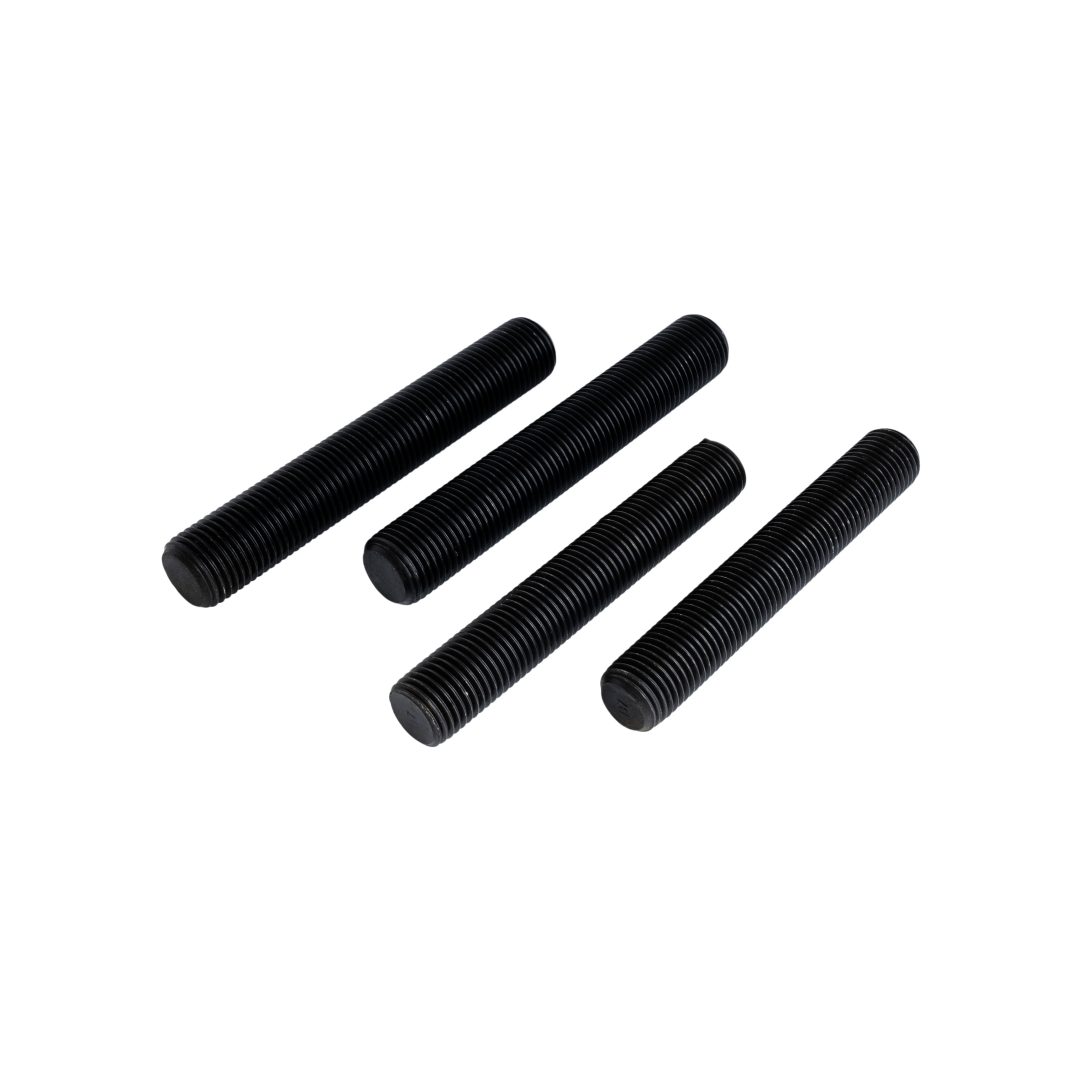
A full thread stud bolt features continuous threading from end to end. The industry universally recognizes it as the standard for flange connections. Continuous threading distributes tension evenly across the entire fastener body. It eliminates weak points commonly found at thread run-out zones. You specify these components for continuous heavy tensioning applications. They accommodate varying flange thicknesses effortlessly. Technicians easily adjust nut placement along the continuous thread. Both ends feature precision chamfers to prevent thread damage during assembly.
A tap end stud bolt features three distinct sections. It has a short threaded section on one end. An unthreaded shank occupies the middle. A longer threaded section sits on the opposite end. Engineers design the short end to be driven directly into a tapped hole. This creates a permanent or semi-permanent fixture in a primary body. You apply a nut to the longer threaded end to secure the mating component. You specify this profile for heavy machinery, engine blocks, and blind-hole applications. The short end typically uses a Class 5 interference fit. This fit prevents the stud from backing out when technicians remove the nut.
A Double-ended stud features threading at both ends separated by an unthreaded center shank. The unthreaded shank matches the major diameter of the threads. You specify this profile for applications requiring specific grip lengths. Sometimes continuous threading proves unnecessary or undesirable for localized structural integrity. The solid shank provides superior resistance to lateral shear forces. We often see these specified in valve bodies and high-vibration equipment mounts. They ensure exact spacing between components while maintaining high tensile strength.
Calculating exact length prevents a dangerous condition known as "short-bolting." Short-bolting severely compromises thread engagement within the nut. It directly risks catastrophic pressure blowouts. Conversely, excessive protrusion causes severe safety hazards. Workers can snag clothing on exposed threads. It also wastes expensive protective coatings and complicates future maintenance. You must evaluate dimensions precisely to ensure optimal joint integrity.
Measurement standards differ across global engineering practices. You must clearly differentiate between End-to-End (E-to-E) and First-Thread to First-Thread (FTF) measurements. ASME B16.5 standards strictly dictate these requirements for pipeline applications. FTF measures the distance excluding the chamfered ends. E-to-E includes the chamfers in the total length. Always confirm which measurement standard your facility uses before ordering.
Formulaic calculations pose a significant implementation risk if done incorrectly. You must factor in multiple variables to calculate the correct length. A single missing variable compromises the entire joint setup.
Table: Core Variables for Length Calculation
Calculation Variable | Engineering Definition | Impact on Assembly |
|---|---|---|
Flange Thickness | Combined thickness of both mating flanges. | Determines the baseline grip length requirement. |
Gasket Compression | Thickness of the sealing element under fully torqued load. | Alters final measurement; uncompressed thickness causes calculation errors. |
Washer Thickness | Total height of all structural washers used in the joint. | Adds directly to the required span length. |
Nut Height | Height of two heavy hex nuts combined. | Ensures enough thread exists to fully capture the nuts. |
Thread Protrusion | Exposed threads extending past the outer nut face. | Mandatory 1-2 threads ensure complete mechanical engagement. |
Standardization rules are also shifting based on diameter. The industry relies heavily on UNC (Unified National Coarse) threads for standard sizes. However, they switch to the 8-UN (Eight-Thread) series for bolts larger than one inch. The 8-UN standard maintains exactly eight threads per inch regardless of diameter increases. This crucial shift maintains assembly reliability. It prevents the threads from becoming too coarse on massive fasteners. Finer threads on large diameters allow for more precise torque application and higher tensioning control.
Security and compliance depend entirely on correct material selection. You must match fastener metallurgy to specific operational environments. Temperature extremes and highly corrosive media dictate your exact metallurgical choices. Standard ASTM grades govern these decisions across the industrial landscape. Choosing incorrect materials leads to rapid galvanic corrosion and thermal failure.
ASTM A193 Grade B7 offers exceptionally high tensile strength. Manufacturers create it from chromium-molybdenum alloy steel. They subsequently quench and temper it for maximum durability. We use it as the universal standard for high-temperature and high-pressure service. This grade strictly requires matching ASTM A194 Grade 2H heavy hex nuts. Mixing incompatible grades causes unequal thermal expansion rates. This unequal expansion eventually fractures the joint assembly.
ASTM A193 Grade B8 or B8M consists of austenitic stainless steel. Engineers specify these specifically for highly corrosive environments. Grade B8 matches with AISI 304 stainless steel. Grade B8M includes molybdenum for pitting resistance, matching AISI 316 stainless steel. They absolutely require matching Grade 8 or Grade 8M nuts.
You must emphasize the industrial requirement when purchasing a stud bolt with nuts. You must source them together as paired, certified assemblies. Buying components separately from different vendors introduces massive compliance risks. A paired assembly guarantees compatible yield strengths across the entire joint load.
Coatings also heavily alter performance realities in the field. Bare metal rarely survives long in chemical plants or offshore rigs. You might evaluate PTFE (Teflon), Cadmium, or Zinc plating to extend lifecycle performance. PTFE prevents galling and offers excellent chemical resistance. However, you must note the dimensional tolerances required when specifying heavy coatings. Thick zinc galvanizing or multi-layer PTFE can easily cause thread binding during assembly. Engineers must specify oversized tapped nuts to accommodate these protective layers.
Evaluating fastener suppliers requires an intense focus on quality assurance. You simply cannot rely on unit price alone. Catastrophic joint failures cost millions in environmental fines and lost production. Premium hardware costs pennies compared to facility downtime.
Mandate 100% traceable Material Test Reports (MTRs) from all vendors. Visual inspection cannot identify metallurgical flaws. MTRs confirm precise physical and chemical properties. They verify the exact heat lot, tensile strength, yield strength, and hardness levels. If a supplier hesitates to provide an MTR, disqualify them immediately.
Risk mitigation requires strict vendor control. Avoid generic or unbranded fasteners in critical load-bearing applications. Low-quality manufacturing carries a severe risk of hydrogen embrittlement. This occurs when hydrogen atoms become trapped in the steel during cheap plating processes. The metal becomes brittle and shatters under high tension without warning. Counterfeit grading is also a massive industry problem. Substandard steel falsely stamped as Grade B7 will fail catastrophically under pressure.
Structuring your Request for Quote (RFQ) correctly prevents costly purchasing errors. A vague RFQ yields incorrect hardware. Follow this structured checklist when sourcing:
Quantity: Specify exact numbers and request minimum order quantities.
Type: Clearly define the exact profile required for the application.
Diameter & Pitch: List nominal diameter and specific thread series (UNC vs 8-UN).
Length Standard: State whether the measurement is E-to-E or FTF.
Material Grade: Define the ASTM standard for both the stud and the nuts.
Coating Specification: Detail the exact plating or fluoropolymer coating required.
Certification: Explicitly demand full MTR documentation upon delivery.
Specification is a sequential, highly controlled process. You start by determining the mechanical joint requirement to select the proper type. You follow this by calculating exact dimensional accuracy to ensure perfect length and engagement. Finally, you ensure environmental compliance through strict material and coating selection. Skipping any step compromises the entire system.
We strongly recommend partnering with specialized manufacturers. Look for facilities that control the threading and heat-treating processes in-house. This direct oversight guarantees strict ASME and ASTM compliance. Proper evaluation and sourcing ensure your flanged connections remain leak-free, safe, and fully operational for years.
A: Piping applications typically use the Unified National Coarse (UNC) thread series for diameters under one inch. Once the diameter reaches one inch and above, the standard transitions to the 8-UN (Eight-Thread) series. This provides exactly eight threads per inch regardless of diameter, ensuring optimal tensioning and reliable clamping force for large heavy-duty flanges.
A: Industry standards universally require one to two complete threads protruding beyond the outer face of the heavy hex nut. This visual confirmation guarantees full mechanical thread engagement. Excessive protrusion wastes coating and introduces snagging hazards. Conversely, zero protrusion risks catastrophic joint failure due to insufficient load transfer.
A: You should never reuse these fasteners in critical high-pressure applications. Previous torque applications cause microscopic thread stretching and metallurgical yielding. Reusing them significantly increases the risk of thread galling. It also prevents accurate tensioning upon reinstallation. Always specify fresh hardware during maintenance turnarounds to ensure ultimate safety and joint integrity.
A: A threaded rod is a generic bulk product used for light-duty suspension or general construction. A stud fastener is a highly engineered industrial component. It features specific ASTM material heat treatments, rigorous threading tolerances, and precision-chamfered ends. Engineers design these specifically for extreme load-bearing applications and high-pressure flanged connections.


