
Views: 0 Author: Site Editor Publish Time: 2026-08-21 Origin: Site


Fastener failure in high-pressure and high-temperature piping systems directly translates to catastrophic leaks. These dangerous events trigger unplanned downtime, massive environmental cleanup costs, and severe safety hazards for on-site personnel. Securing heavy flanged joints requires highly precise tensioning, uncompromising material compliance, and highly predictable lifecycle performance. Strict adherence to metallurgical standards plays a critical role here. This article outlines the engineering rationale for utilizing a stud bolt in demanding industrial piping systems. We establish standard evaluation criteria for advanced material selection. You will also learn about practical procurement realities and modern installation protocols. These insights help engineers ensure full alignment against stringent ASME and API requirements. Choosing the correct industrial fasteners safeguards your physical infrastructure while drastically minimizing operational risk across the facility.
Continuous threading and symmetry make stud bolts the standard for securing ASME B16.5 pipe flanges.
Material selection must strictly align with operating environments, primarily dictated by ASTM A193 (high-temp) and ASTM A320 (low-temp) standards.
Thread galling and pre-load loss are the highest-probability installation risks, requiring controlled torque or hydraulic tensioning.
Procurement evaluation relies entirely on verifiable Mill Test Reports (MTRs) and strict dimensional tolerance validation.
Standardizing joint connections minimizes maintenance turnaround time. It also prevents uneven gasket compression across critical high-pressure systems. Plant operators constantly battle tight production schedules and strict safety mandates. Standardized connections streamline these highly demanding maintenance cycles. Predictable joint behavior keeps facilities running smoothly.
Unlike headed bolts, a continuously threaded stud bolt distributes mechanical stress evenly across its entire length. This inherent symmetry dramatically reduces localized fatigue zones. Headed fasteners often concentrate dangerous shear stress right below the bolt head. Continuous threads eliminate this structural weak point entirely. The resulting uniform stretch handles cyclic loading much better over time. API flanges utilized in wellhead equipment demand strictly controlled tensioning protocols. The uniform nature of continuous threads ensures these massive flanges remain securely mated during violent pressure spikes.
Studs also enable highly precise, dual-sided nut tightening. This specific setup allows field crews to apply modern hydraulic tensioning equipment. Hydraulic tensioners are completely critical for achieving uniform pre-load on large-diameter pipe flanges. Standard manual torque methods often struggle on massive pipe joints due to immense friction.
Field maintenance realities dictate highly practical hardware choices. Restrictive pipe racks or highly corrosive offshore environments frequently cause fasteners to seize solid. Frozen studs offer an easy, safe removal path. Maintenance crews can safely cut or split nuts on either end. They accomplish this heavy removal without ever damaging the extremely expensive flange face. Conversely, seized hex bolts frequently score or damage surrounding equipment during difficult mechanical extractions.
Selecting the correct industrial fastener demands rigorous evaluation against precise system conditions. Engineers must carefully align bolt tensile strength alongside exact pipeline pressure classes. For instance, a basic Class 150 flange requires drastically different clamping force compared to an extreme Class 2500 joint. The structural demands multiply exponentially as system pressures rise. Fastener yield strength must match these escalating requirements flawlessly.
Dimensional standard verification remains completely non-negotiable for project success. Piping professionals ensure strict alignment under ASME B16.5 codes for guaranteed flange compatibility. Furthermore, thread pitch must perfectly adhere to ASME B1.1 guidelines. Coarse threads dominate smaller diameters. However, heavy industrial applications typically specify UNC (Unified National Coarse) or 8-UN threading for any diameters exceeding one inch. The 8-UN series standardizes the pitch for large applications. This standardization prevents technicians from stripping threads during heavy hydraulic tensioning.
Environmental threat assessments directly dictate your baseline coating and alloy needs. Evaluators look closely at specific, localized exposure risks before ordering materials. Marine and offshore environments heavily promote rapid galvanic corrosion due to saltwater exposure. Petrochemical processing streams often introduce severe hydrogen embrittlement risks to high-strength steel. You must match the alloy's chemical defenses to the exact media flowing through the pipe.
Best Practices for Material Evaluation:
Always map your material yield strength directly to the exact flange pressure ratings.
Consult the official ASME B16.5 tables to verify exact lengths before installation.
Identify all localized environmental threats before finalizing any surface coatings.
Double-check thread pitch compatibility between the stud and the heavy hex nuts.
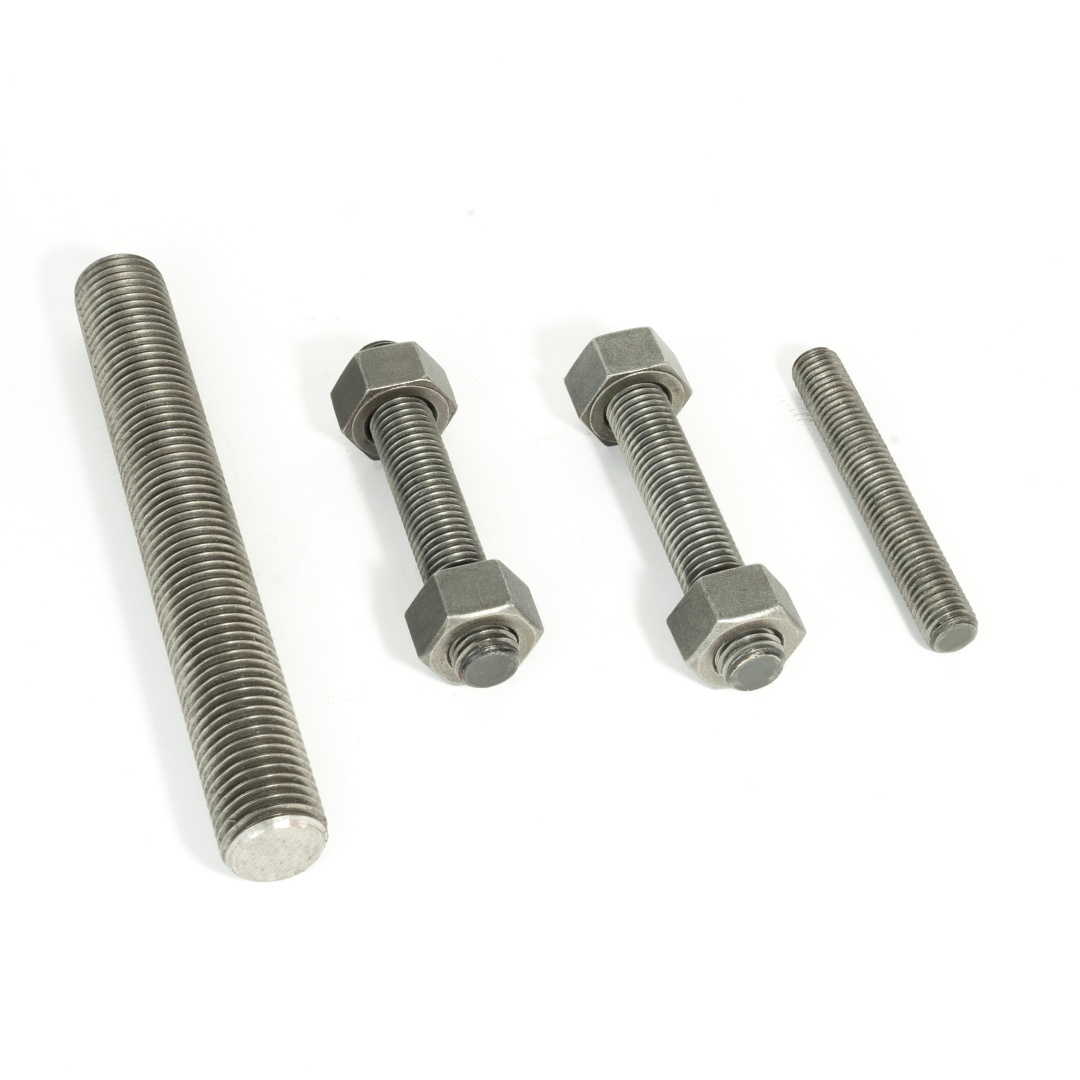
Piping systems operate across extreme temperature gradients. Proper material selection relies heavily on internationally established ASTM protocols. Getting the alloy wrong leads to rapid structural degradation.
High-Temperature Applications rely primarily on ASTM A193 specifications. Grade B7 serves as the undisputed industry baseline for standard high-temp, high-pressure environments. It handles typical steam and hydrocarbon piping demands highly effectively. However, highly corrosive chemical media necessitate entirely different alloys. Grade B8 and Grade B8M deploy high-quality austenitic stainless steel. These correspond to standard 304 and 316 steel equivalents. They effectively resist aggressive chemical degradation while maintaining reasonable core strength.
Low-Temperature and cryogenic systems fall under strict ASTM A320 parameters. Grade L7 features highly engineered impact toughness. It operates flawlessly in extreme sub-zero processing environments. Liquefied Natural Gas (LNG) facilities utilize L7 fasteners extensively to prevent brittle fracture at ultra-low temperatures.
Surface treatments introduce necessary engineering trade-offs. You must carefully balance corrosion resistance against specific torque friction requirements.
Surface Treatment Comparison Chart
Coating Type | Primary Advantage | Key Limitation | Best Use Case |
|---|---|---|---|
PTFE / Xylan | Low friction coefficient, highly accurate torque | Degrades at extremely high operating temperatures | Offshore platforms, chemical washdown areas |
Hot Dip Galvanizing (HDG) | Outstanding physical durability and rust prevention | Adds thread thickness, requires nut overtapping | General outdoor structural piping lines |
Zinc Plating | Cost-effective basic corrosion shield | Easily scratched, poor in highly acidic media | Indoor utility lines, low-risk environments |
Cadmium Plating | Excellent lubricity and marine resistance | High environmental toxicity concerns | Specialized aerospace or legacy marine joints |
PTFE and Xylan coatings offer excellent corrosion resistance profiles. They feature reliably lower friction coefficients for highly accurate torque delivery during assembly. However, maximum operating temperatures strictly limit their widespread application. Extreme heat literally burns these fluoropolymer coatings away.
Hot Dip Galvanizing (HDG) delivers outstanding overall physical durability. The heavy zinc dipping process adds noticeable metallic thickness to the fastener threads. This added thickness fundamentally alters the fit. It requires specialized nut overtapping to ensure smooth assembly. Crews must also perform highly careful tensioning calculations to compensate for the altered thread friction dynamics.
Even the highest quality stud bolt inevitably fails if field crews install it improperly. Austenitic stainless steel faces uniquely significant cold-welding risks. Grades like B8 and B8M gall very easily under high compression. This galling destroys the threads instantly. Mitigation requires applying specialized anti-seize lubricants generously. Molybdenum disulfide or copper-based pastes provide the necessary lubrication barrier. Technicians must apply these compounds consistently across the engaged threads and the nut bearing surface. Inconsistent lubrication creates wild variations in actual clamping force. Crews must employ slow, highly sequential star tightening patterns. Fast pneumatic power tools guarantee destructive thread galling on stainless hardware.
Torque application inherently introduces massive, unpredictable friction variables. Traditional torque wrenches fight thread and nut face friction rather than directly stretching the fasteners. This creates severe inconsistencies in joint clamping force. Modern hydraulic tensioners provide pure, predictable axial load. Engineers heavily highlight the absolute necessity of hydraulic tensioners for studs larger than 1.5 inches in diameter. Pure tensioning eliminates dangerous friction uncertainties entirely. It physically stretches the bolt to the exact required yield point before the nut is seated.
Gasket creep inevitably causes joint relaxation post-installation. Piping systems undergo intense physical thermal cycling during initial startup phases. Materials expand and contract drastically. You must account for this inevitable relaxation engineering. Establishing strict maintenance protocols for subsequent torque passes prevents sudden, catastrophic leaks.
Common Mistake: Skipping the necessary re-torque cycle after the initial thermal expansion run often leads directly to blown gaskets and expensive plant shutdowns.
Sourcing heavy industrial fasteners demands exceedingly stringent quality controls. Procurement logic in the piping industry heavily favors verifiable, unbroken traceability. Taking risks on unverified hardware invites massive operational disaster.
Mill Test Reports (MTRs) represent an absolutely non-negotiable procurement requirement. These critical documents detail the exact chemical compositions of the raw steel. They record precise heat treatments, charpy impact test results, and final physical mechanical properties. Missing or forged MTRs must disqualify any potential vendor immediately.
Supplier Quality Management Systems (QMS) establish the basic foundation of supply chain trust. Savvy buyers deliberately shortlist manufacturers holding valid ISO 9001 and API production certifications. These stringent credentials protect massive projects against dangerous counterfeit alloys. They also eliminate substandard raw materials from entering the supply chain entirely. Audited facilities produce predictably safe hardware.
Lead-time management requires highly careful logistical planning. Standard B7 studs usually boast excellent inventory availability worldwide. You can source them quickly for emergency repairs. Conversely, specialty chemical lines require highly exotic alloys like Monel, Inconel, or Hastelloy. These specific variants feature heavily extended procurement cycles, often spanning several months.
Follow these exact next-step actions to properly secure your upcoming piping project:
Compile all intended fluid types, operating pressures, and maximum temperature limits.
Conduct a comprehensive joint walk-through of the project specifications alongside your team.
Consult a certified, experienced industrial fastener engineer to review your findings.
Verify all requested surface coatings against the expected installation torque methods.
Lock in exact material requirements strictly before issuing any formal RFQs to suppliers.
Proper stud bolt specification directly governs overall piping system integrity and personnel safety. Industrial fasteners are never just simple, interchangeable commodities. They act as the primary defense against catastrophic system failure. Over-specifying fancy coatings or extreme grades without fully understanding installation torque realities leads directly to unexpected joint failure. Exotic materials certainly solve complex chemical corrosion problems, but they heavily complicate project lead times. You must strategically balance theoretical engineering with practical field application.
Take decisive action by gathering your current isometric drawings today. Review your existing flange specifications thoroughly against the ASTM guidelines detailed above. Submit these comprehensive documents to your trusted engineering partners for a deep technical review and an accurate material quote. Securing highly reliable, leak-free connections always starts during the meticulous planning phase.
A: The standard calculation combines flange thickness, gasket thickness, and nut thickness for both ends. You must also include sufficient thread protrusion. Industry standards typically require two to three full threads extending past the nut on each side. This ensures full nut engagement and allows room for hydraulic tensioning equipment.
A: Industry guidelines like ASME PCC-1 strongly discourage fastener reuse in high-pressure systems. Disassembly causes localized thread yielding and severe loss of coating integrity. Re-tightening a used fastener introduces unpredictable friction coefficients. This makes accurate tensioning impossible and drastically increases the risk of joint failure.
A: Continuous full-thread studs act as the standard for flange-to-flange connections. They allow nuts on both ends for even tensioning. Tap-end studs feature a short thread engagement section on one side. Engineers use tap-end variants to thread directly into tapped equipment casings or blind holes.


