
Views: 0 Author: Site Editor Publish Time: 2026-09-16 Origin: Site


Fastener failure in high-pressure systems carries severe operational consequences. A single compromised connection can lead to catastrophic blowouts, fugitive emissions, and unplanned facility downtime. Many operators treat fasteners as generic commodities. This misconception puts entire plants at risk. Securing heavy-duty flanged joints requires precise management of thermal expansion, pure tension, and extreme mechanical stress. You must also account for specific joint design requirements to maintain system integrity.
Specifying the correct fastener is a complex engineering decision. You must evaluate load requirements, joint design, and environmental realities. Strict industry compliance is mandatory. We will explore a systematic framework for selecting the exact fastener needed to keep high-pressure systems sealed, safe, and operational under extreme conditions.
Mechanical Superiority: A stud bolt allows for pure tension during tightening, eliminating the torsional stress inherent in hex bolts and ensuring uniform stress distribution across flanged connections.
Material and Environmental Alignment: Selecting the right industrial stud bolt requires matching material grades and protective coatings to specific operational extremes (e.g., cryogenic temperatures, highly corrosive chemicals).
Preload Precision: The physical specification of the bolt is only half the equation; calculating and applying the correct preload is critical to maintaining joint integrity under dynamic pressure.
Standard Compliance: Verifying material test reports (MTRs) against ASME, ASTM, and API standards is a non-negotiable step in mitigating liability and ensuring safety.
Hex bolts present a distinct mechanical disadvantage in heavy-duty applications. When you tighten the head of a hex bolt, you introduce twisting forces into the fastener body. This torsional stress consumes a significant portion of the material's yield strength before the flange even compresses. The metal must handle both the twist and the stretch simultaneously. This combination lowers the overall load-bearing capacity of the fastener.
Consider what happens when a technician applies a wrench to a standard headed bolt:
The tool applies rotational force directly to the bolt head.
Friction under the head and within the internal threads resists this rotation.
The shank twists, consuming up to half of the material's yield strength just to overcome friction.
The remaining strength is left for actual clamping force, severely limiting performance under pressure.
High-pressure environments require a different mechanical approach. Tightening nuts on a stud bolt puts the fastener into pure tension. The threaded rod itself does not rotate during installation. The nuts draw the ends outward, stretching the steel axially. This pure axial stretch maximizes the load-bearing capacity of the metal. Eliminating torsional stress makes this configuration the absolute standard for securing pressure vessels and piping systems.
Flanged joints rely on uniform gasket compression to prevent leaks. Uneven clamping force creates high-stress points that crush gaskets while leaving adjacent areas loose. Fasteners must deliver consistent, predictable force across the entire flange face. Headed bolts often struggle to provide this uniformity due to the transition zone between the unthreaded shank and the threaded portion. This transition acts as a stress riser, creating a weak point where fatigue failures initiate.
Symmetrical threading solves this problem. A continuously threaded fastener allows for predictable elongation. As you apply torque or hydraulic tension, the load distributes evenly along the entire length of the engaged threads. This symmetrical load distribution prevents localized yielding. It keeps the flange faces perfectly parallel, maintaining the exact gasket crush required to seal volatile fluids and gases. When pressure spikes occur, the uniform stretch absorbs the shock without compromising the seal.
Fully threaded configurations feature continuous threading from end to end. Engineers specify these primarily for standard flanged connections and high-temperature piping. The continuous thread design offers significant mechanical advantages. It equalizes stress along the entire length of the fastener, preventing weak points from forming at thread run-out zones. You do not have to worry about a shank transition failing under cyclic loading.
Maintenance teams prefer fully threaded options for their operational flexibility. During plant turnarounds, technicians can easily assemble and disassemble these connections. If threads become damaged on one end, the symmetrical design often allows for easier removal compared to headed bolts. They accommodate slight variations in flange thickness without requiring custom lengths. You can stock standard lengths and cover a wide variety of flange classes across the facility.
Not all applications require continuous threading. Tap-end configurations feature unequal thread lengths on either side of an unthreaded center shank. The shorter end features an interference fit. You drive this end directly into a tapped blind hole. This creates a semi-permanent connection, commonly found in heavy machinery bodies, large engine blocks, and compressor housings. The interference fit locks the fastener in place, allowing technicians to remove the top nut without backing the rod out of the casting.
Double-end configurations feature equal thread lengths on both ends, separated by an unthreaded center. Engineers use these for specific grip lengths where the unthreaded shank must match the exact thickness of the joined materials. You will find double-end designs in custom heavy equipment assemblies and specialized valve bodies. Choose tap-end designs for permanent anchoring into machined bodies. Select double-end designs when you need a precise grip length but anticipate frequent disassembly.
The physical geometry of the fastener directly impacts installation success. Chamfered ends are non-negotiable for field assembly. A chamfer is a beveled edge at the tip of the rod. This bevel facilitates smooth nut engagement. It prevents technicians from cross-threading the nuts during rapid assembly. Without chamfered ends, the first thread often suffers damage from impact or misalignment, forcing crews to waste time re-threading or replacing the hardware.
Thread series selection determines the mechanical grip. The 8-UN (8 threads per inch) series is the industry standard for high-pressure fasteners over one inch in diameter. Standard Coarse Thread (UNC) becomes too deep on large diameters. Deep threads reduce the minor diameter (root area) of the bolt, which drastically lowers its tensile strength.
Nominal Diameter | Thread Series | Threads Per Inch (TPI) | Root Area Impact |
|---|---|---|---|
1-1/8" | UNC | 7 | Reduces core strength significantly |
1-1/8" | 8-UN | 8 | Maintains larger root area, higher tension |
1-1/2" | UNC | 6 | Deep threads compromise yield strength |
1-1/2" | 8-UN | 8 | Industry standard for pressure vessels |
A high-strength rod requires equally robust mating components. Standard nuts will strip long before the rod reaches its yield point. You must specify heavy hex nuts, such as those meeting ASTM A194 specifications. Heavy hex nuts feature a larger width across the flats and greater thickness. This extra material guarantees the nut matches or exceeds the tensile strength of the rod. If the system over-pressurizes, the rod should stretch before the nut threads shear off.
Hardened washers play an equally vital role in the assembly. Follow these guidelines for washer implementation:
Place hardened washers under every turned nut to provide a consistent bearing surface.
Use them to distribute the massive clamping load over a wider area of the flange face.
Prevent heavy hex nuts from embedding themselves into softer flange materials during tightening.
Maintain accurate torque-to-tension conversion by stabilizing the friction coefficient under the nut.
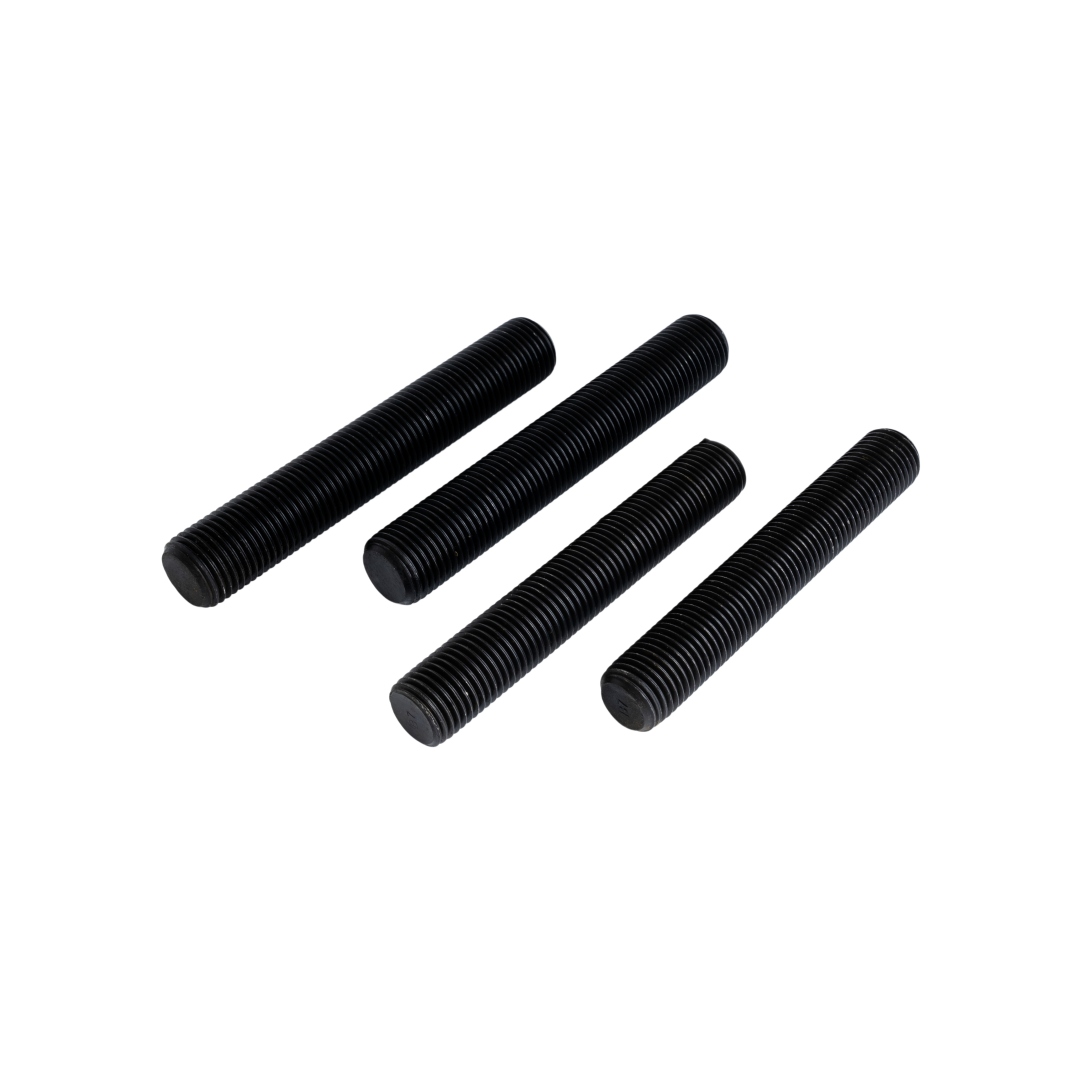
The specific joint design dictates the required dimensions of your fasteners. You must account for the exact flange thickness, the compressed thickness of the gasket, and the flange face type. Raised face flanges require different calculations than flat face or ring-type joint (RTJ) flanges. A miscalculation here leads to catastrophic assembly issues in the field. If crews arrive with hardware that is half an inch too short, the entire hydro-testing schedule halts.
Effective grip length is the exact distance between the bearing faces of the nuts. Calculating this dimension accurately prevents thread bottoming. Follow this standard formula for sizing:
Measure the thickness of both mating flanges.
Add the fully compressed thickness of the specified gasket.
Add the thickness of two hardened washers.
Add the height of two heavy hex nuts.
Add enough length to leave exactly two full threads exposed beyond each nut for visual inspection.
Material grade determines the operational limits of the connection. You must map the yield strength and tensile strength of the fastener directly to the system's maximum allowable working pressure (MAWP). Standard carbon steel fails under extreme pressure and heat. You must rely on specific ASTM grades designed for severe service. Using the wrong alloy results in immediate yielding during the initial pressure test.
ASTM Grade | Material Type | Primary Application | Temperature Range |
|---|---|---|---|
A193 B7 | Chromium-Molybdenum Steel | High pressure, high temperature piping | Up to 1000°F (538°C) |
A193 B7M | Modified Cr-Mo Steel | Sour gas (H2S) environments | Up to 1000°F (538°C) |
A193 B16 | Chromium-Molybdenum-Vanadium | Extreme heat, power generation | Up to 1100°F (593°C) |
A193 B8/B8M | 304/316 Stainless Steel | Corrosive chemical processing | Cryogenic to 1500°F (815°C) |
A320 L7 | Alloy Steel (Charpy Impact Tested) | Cryogenic applications, LNG facilities | Down to -150°F (-101°C) |
Temperature dictates material behavior just as much as pressure. In low-temperature environments, standard steel undergoes a ductile-to-brittle transition. A sudden pressure spike or physical impact will shatter a standard bolt in cryogenic conditions. You must specify ASTM A320 L7 materials for these applications. Mills test L7 steel specifically for impact toughness at sub-zero temperatures using the Charpy V-notch test. This testing proves the metal will stretch rather than snap when hit with a sudden load in freezing conditions.
High-heat environments introduce the risk of creep. Creep is the slow, permanent deformation of metal under constant stress at elevated temperatures. As the metal creeps, it elongates. This elongation causes a total loss of clamping force, leading to flange leaks. Thermal expansion also plays a role. The fastener material must expand at a similar rate to the flange material. If the bolt expands faster than the flange, the joint loosens. Grades like B16 contain vanadium to resist creep and maintain tension in extreme heat.
Bare steel rapidly degrades in industrial environments. Corrosion eats away at the thread root, destroying the load-bearing capacity of the connection. You must evaluate surface coatings based on the specific environmental threat. PTFE (Teflon) coatings offer excellent chemical resistance and prevent rust in offshore environments. Zinc plating provides basic sacrificial protection, while hot-dip galvanizing (HDG) offers a thick, durable barrier for structural applications exposed to weather.
Coatings drastically alter the installation mechanics. The friction coefficient (K-factor) changes depending on the surface finish. A PTFE-coated fastener is highly lubricated. It requires significantly less torque to achieve the target preload compared to a bare steel fastener. If you apply bare-steel torque values to a PTFE-coated fastener, you will over-stretch the steel and yield the bolt. Always adjust your torque calculations based on the specific lubricity of the chosen coating.
Engineers constantly weigh initial material costs against mechanical performance. Standard B7 alloy steel provides exceptional strength for most high-pressure applications. It is readily available and mechanically reliable. However, highly corrosive environments quickly destroy B7 steel. In chemical processing plants or offshore oil rigs, standard alloys fail rapidly. Saltwater and acidic vapors eat through standard coatings, requiring constant replacement and monitoring.
Exotic materials like Inconel, Monel, or Hastelloy offer extreme resistance to harsh chemicals and saltwater. They maintain their mechanical properties in environments that dissolve standard steel. You justify the use of exotic alloys by evaluating the mechanical limits of the system. When standard steel cannot survive the chemical exposure or temperature extremes, exotic alloys become the only viable engineering solution to maintain joint integrity. The upfront material cost pales in comparison to the cost of a catastrophic chemical leak.
Investing in higher-grade materials or advanced coatings directly reduces long-term maintenance frequency. Fasteners that resist corrosion and creep do not require constant retorquing or early replacement. This stability extends the operational lifecycle of the entire piping system. You spend less time sending maintenance crews to address fugitive emissions or weeping flanges. A stable joint allows the facility to run continuously between scheduled turnarounds.
Consider the logistics of plant turnarounds. Seized fasteners create massive delays. When rust fuses the nut to the threads, technicians cannot use standard wrenches. They must resort to destructive removal methods like nut splitting or torching. These methods require hot-work permits, specialized equipment, and significant labor hours. Specifying the right coating and material upfront prevents threads from seizing. This guarantees rapid, non-destructive disassembly during critical maintenance windows, getting the plant back online faster.
The most critical phase of fastener implementation is the tightening process. Under-tightening leaves the gasket under-compressed. As system pressure fluctuates, the joint will leak, releasing fugitive emissions. Over-tightening is equally dangerous. Excessive force yields the bolt, permanently stretching the steel beyond its elastic limit. It can also crush the gasket, destroying its ability to seal. Relying on feel or uncalibrated tools guarantees failure.
You must implement strict mitigation tactics to manage preload. Standard torque wrenches are often inaccurate due to variable friction. For critical high-pressure joints, use calibrated hydraulic tensioners. Follow this tensioning process:
Thread the tensioner onto the exposed threads above the nut.
Apply hydraulic pressure to stretch the bolt axially to the exact target load.
Run the nut down against the flange face by hand.
Release the hydraulic pressure, transferring the load directly to the nut.
This method eliminates friction from the preload calculation. For ultimate accuracy, use ultrasonic elongation measurement to verify the exact stretch of the steel after installation.
Thread galling is a severe risk when installing stainless steel or alloy fasteners. Galling, or cold-welding, occurs when pressure and friction cause the thread surfaces to microscopically fuse together. As the technician forces the nut further, the threads tear and lock up completely. Once an Industrial Stud Bolt galls, you must cut it off. You cannot reverse the nut. This destroys the hardware and halts assembly.
Prevention requires strict installation protocols. Never install stainless steel fasteners dry. You must apply high-quality anti-seize compounds containing nickel or molybdenum disulfide to the threads and the bearing face of the nut. Control your tightening speed. High-speed impact wrenches generate massive heat, which accelerates galling. Use slow, controlled tightening methods. Finally, ensure all threads are perfectly clean and free of debris before assembly. A single grain of sand can trigger a galling event.
Critical infrastructure relies on verified material properties. Substandard or counterfeit fasteners look identical to high-grade components but fail catastrophically under pressure. Counterfeiters often stamp fake grade markings on low-carbon steel. Installing these in a high-pressure system guarantees a blowout. You cannot visually distinguish between a piece of mild steel and a heat-treated B7 alloy.
You must establish rigid supply chain integrity. Because these fasteners lack traditional heads, manufacturers stamp the grade markings and manufacturer identification on the flat ends of the rod. Verify these end markings upon receipt. Furthermore, demand traceable Material Test Reports (MTRs) from your vendors for every batch. The MTR proves the chemical composition and physical testing results of the steel heat lot. Never install a fastener in a critical system without verifying its MTR against the required ASTM standard.
Specifying fasteners for high-pressure systems is a rigorous engineering discipline. You must balance mechanical strength, joint design compatibility, environmental resilience, and precise installation protocols. A failure in any of these areas compromises the entire system. Follow these immediate next steps to secure your infrastructure:
Audit your current fastener inventory to verify all materials match the specific pressure and temperature ratings of their respective systems.
Establish strict QA/QC procedures to verify end grade markings and cross-reference all incoming Material Test Reports (MTRs).
Update your installation procedures to mandate specific K-factor adjustments for coated fasteners and require anti-seize for all stainless applications.
Transition to hydraulic tensioning or ultrasonic elongation measurement for all critical, high-pressure flanged connections.
A: A threaded rod is typically a generic, low-strength fastener cut to length for light-duty hanging or bracing. A stud bolt is a highly engineered, heat-treated fastener manufactured to strict ASTM standards specifically designed for high-pressure flanged connections and heavy industrial use.
A: Two heavy hex nuts allow the fastener to be put into pure axial tension. By threading a nut on each end, the tightening force pulls the rod symmetrically, stretching it without introducing the torsional stress that occurs when twisting the head of a standard hex bolt.
A: You calculate the length by adding the thickness of both flanges, the compressed thickness of the gasket, the thickness of two hardened washers, the height of two heavy hex nuts, plus the length of two full threads exposed beyond each nut for visual inspection.
A: For diameters over one inch, standard coarse threads become too deep, which significantly reduces the minor diameter of the fastener. The 8-UN series maintains 8 threads per inch regardless of diameter, preserving a larger root area and maintaining higher tensile strength.
A: ASTM A193 B7 indicates a chromium-molybdenum alloy steel that has been quenched and tempered. It signifies high tensile strength and is the industry standard for high-pressure, high-temperature piping applications up to 1000°F (538°C).
A: Prevent galling by ensuring threads are completely clean, applying a high-quality nickel or molybdenum-based anti-seize lubricant, and using slow, controlled tightening methods. Avoid using high-speed impact wrenches, which generate heat and friction that cause cold-welding.
A: Generally, no. High-pressure fasteners are often torqued close to their yield point. Repeated tightening cycles cause metal fatigue and permanent elongation. Reusing them risks unpredictable clamping force and joint failure. Always replace critical fasteners during maintenance turnarounds.


