
Views: 0 Author: Site Editor Publish Time: 2026-06-22 Origin: Site


TL;DR: In the highly demanding and abrasive world of mining operations, the structural integrity of heavy machinery is paramount. The reliability of excavators, crushers, and conveyor systems depends heavily on the quality of their fastening components. Among these critical components, the hot dip galvanized heavy hex nut stands out as an indispensable solution. By offering superior load-bearing capacity, unmatched corrosion resistance through metallurgical zinc bonding, and exceptional durability under extreme vibration, these specialized nuts ensure that mining equipment operates safely and efficiently, minimizing costly downtime and catastrophic structural failures.
Mining environments are universally recognized as some of the most punishing industrial settings on the planet. The equipment deployed in these sectors—ranging from massive draglines and continuous miners to heavy-duty conveyor belts and rock crushers—is constantly subjected to extreme mechanical stress, relentless vibration, abrasive dust, and highly corrosive chemical conditions. At the heart of maintaining the structural integrity of these colossal machines lies a deceptively simple yet highly engineered fastening component. The reliability of these structural connections dictates the safety, productivity, and profitability of the entire mining operation, making the selection of appropriate fastening solutions a critical engineering and operational decision.
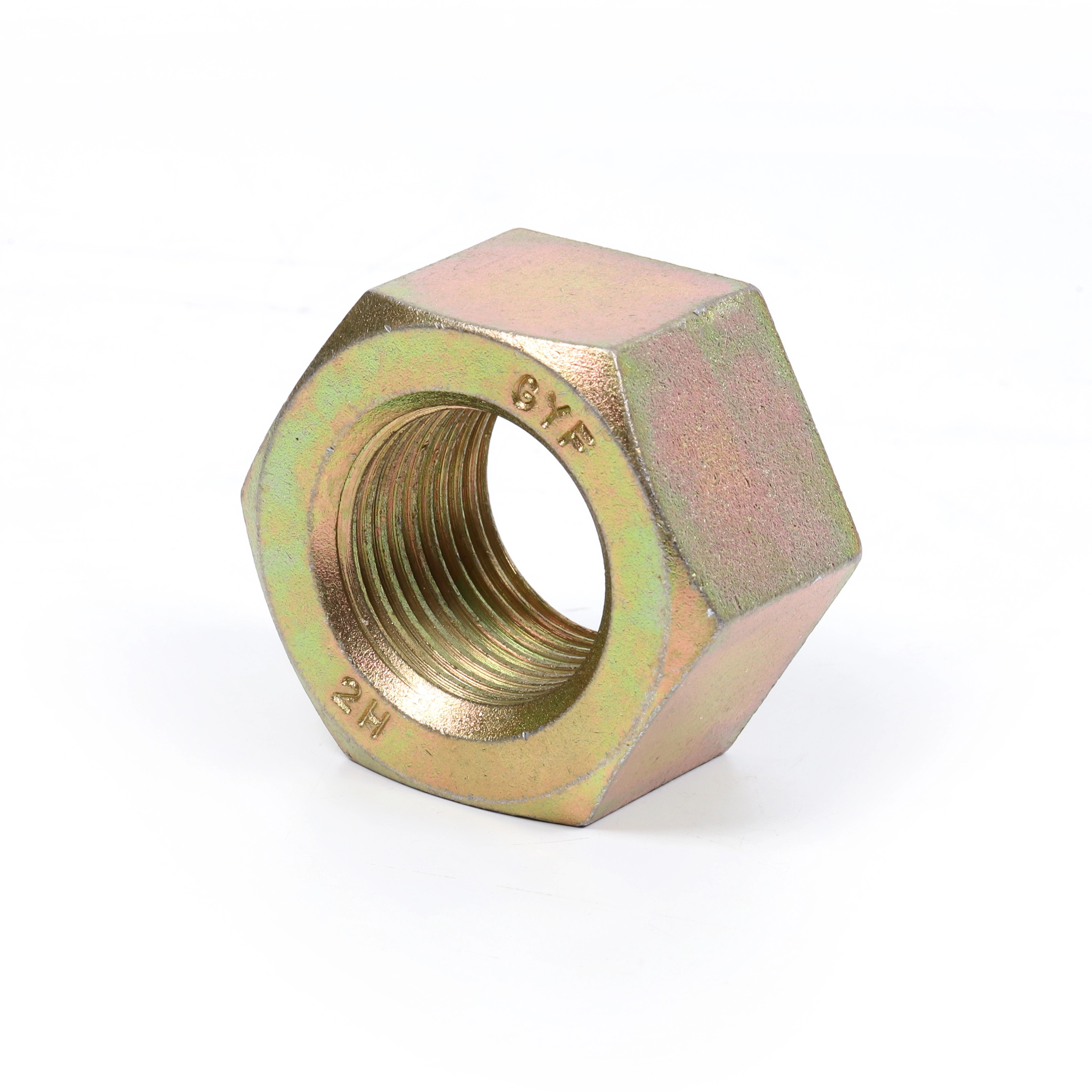
High-strength Hot Dip Galvanized Heavy Hex Nuts designed for rigorous mining equipment structural connections.
When standard fasteners are exposed to the acid mine drainage, high humidity, and fluctuating temperatures typical of subterranean and open-pit mines, they rapidly succumb to oxidation and galvanic corrosion. This degradation compromises the clamping force of the bolted joint, leading to loosening, structural fatigue, and eventual failure. To combat these severe challenges, engineers specify fasteners that combine immense physical strength with impenetrable environmental protection. This is precisely where specialized heavy-duty fastening technology becomes non-negotiable.
Definition: A Hot Dip Galvanized Heavy Hex Nut is a robust, internally threaded fastener characterized by a wider distance across the flats and a greater thickness compared to standard hex nuts. It is coated with a thick, durable layer of zinc through the hot-dip galvanizing process, providing exceptional cathodic and barrier protection against severe corrosion.
To fully appreciate the value of this component, one must break down its two defining characteristics: the "heavy hex" geometry and the "hot-dip galvanized" surface treatment. The heavy hex design provides a larger bearing surface area. This increased footprint distributes the clamping load over a wider section of the structural joint, which is crucial when securing heavy steel plates and flanges on mining machinery. Furthermore, the increased thickness allows for more thread engagement between the nut and the bolt, significantly increasing the proof load and reducing the risk of thread stripping under extreme tension.
The hot-dip galvanizing (HDG) process elevates this high-strength fastener to an industrial powerhouse. Unlike standard zinc plating (electroplating), which deposits a microscopic layer of zinc purely as a surface barrier, hot-dip galvanizing involves immersing the steel nut into a bath of molten zinc at temperatures exceeding 840°F (449°C). This extreme heat triggers a metallurgical reaction between the steel and the zinc, forming a series of tightly bonded zinc-iron alloy layers (Gamma, Delta, and Zeta layers), topped with a pure zinc outer layer (Eta layer). This multi-layered coating is actually harder than the base steel itself, providing outstanding abrasion resistance—a vital feature when the fastener is bombarded by rock dust and debris.
The manufacturing and dimensional tolerances of the Hot Dip Galvanized Heavy Hex Nut are strictly governed by international engineering standards, most notably ASME B18.2.2 for dimensional geometry and ASTM A563 for material properties. These standards ensure that every nut performs predictably under calculated loads.
One of the most critical specifications regarding these nuts is the thread tapping process. Because the hot-dip galvanizing process adds a substantial thickness of zinc to the fastener (typically between 2 to 4 mils, or 50 to 100 microns), a standard bolt will not thread into a standard nut after both have been galvanized. To accommodate this added thickness, the threads of the galvanized heavy hex nut are tapped oversize after the galvanizing process. This means the internal threads are bare steel, but they are protected from corrosion by the thick zinc coating on the mating bolt, which acts as a sacrificial anode, providing cathodic protection to the bare internal threads once assembled.
Material Grades: Commonly manufactured in grades such as ASTM A563 Grade C, C3, D, DH, and DH3, matching the strength requirements of high-strength structural bolts like ASTM F3125 Grade A325 and A490.
Thread Series: Typically Unified National Coarse (UNC) or metric equivalents, as coarse threads are less susceptible to galling and easier to assemble in dirty mining environments.
Coating Thickness: Governed by ASTM A153, ensuring a minimum coating weight that guarantees decades of corrosion resistance in harsh environments.
Mining operations present a unique confluence of destructive forces. Equipment such as jaw crushers, ball mills, and vibratory screens generate immense dynamic loads and high-frequency vibrations. Simultaneously, the environment is often saturated with groundwater, acidic runoff, and reactive minerals. In such scenarios, standard carbon steel fasteners would rust within days, and even stainless steel can suffer from chloride-induced stress corrosion cracking.
The deployment of reliable mining equipment fasteners is therefore a matter of operational survival. The hot-dip galvanized coating provides two distinct types of protection. First, it acts as an impermeable barrier, sealing the underlying high-strength steel away from moisture and oxygen. Second, and more importantly, zinc is highly anodic to steel. If the coating is scratched or gouged by falling rocks or heavy tools—a common occurrence in mining—the surrounding zinc will preferentially corrode to protect the exposed steel. This sacrificial protection prevents rust from undercutting the coating and compromising the fastener's structural integrity.
Furthermore, the heavy hex profile is specifically designed to handle the massive torque required to achieve the necessary clamping force in heavy machinery. When assembling the boom of an excavator or the structural framework of a conveyor system, the bolts must be tensioned to their optimal proof load to prevent joint slip. The robust geometry of the heavy hex nut ensures that it can withstand the torsional forces applied by hydraulic torque wrenches without deforming or failing.
In structural engineering, the bolted joint is often the most critical point of failure. The primary function of a high-strength bolted connection is to clamp two or more steel members together so tightly that the friction between the plates carries the shear load, rather than the bolt shank itself. This is known as a slip-critical connection.
Achieving and maintaining this clamping force requires a structural connection fastener that will not yield under immense tension. The Hot Dip Galvanized Heavy Hex Nut excels in this dynamic. Because it is wider and thicker, the shear area of the internal threads is significantly larger than that of a standard nut. When a high-strength bolt is tensioned to 70% or more of its ultimate tensile strength, the heavy hex nut distributes that massive load evenly, preventing thread stripping and ensuring the joint remains rigid even when subjected to the violent, repetitive shocks of mining excavation and rock crushing.
The production of a high-quality corrosion resistant nut destined for the mining sector is a rigorous, multi-stage process that combines heavy industrial forging with precise chemical engineering. Understanding this process highlights why these fasteners are so resilient.
1. Cold or Hot Forging: The process begins with high-grade steel wire or bar stock. Depending on the size and grade of the nut, the raw material is either cold-formed or hot-forged into the heavy hex shape. Hot forging is typically used for larger diameters, where the steel is heated to an austenitic state to allow for massive deformation without cracking.
2. Machining and Initial Threading: Once the blank nut is formed, it is machined to exact tolerances. In some manufacturing workflows, a pilot hole is drilled or punched, preparing the nut for the threading process.
3. Surface Preparation: Before galvanizing, the steel must be immaculately clean. The nuts undergo a caustic wash to remove oils and machining fluids, followed by a pickling process in dilute sulfuric or hydrochloric acid to remove mill scale and rust. Finally, they are dipped in a flux solution (usually zinc ammonium chloride) to prevent oxidation before entering the zinc bath.
4. Hot-Dip Galvanizing: The prepared nuts are placed in perforated steel baskets and submerged into a kettle of molten zinc. The immersion time is carefully controlled to allow the metallurgical bonding to occur, forming the tough alloy layers.
5. Centrifuging: Immediately upon removal from the molten zinc, the baskets are spun in a high-speed centrifuge. This critical step uses centrifugal force to throw off excess liquid zinc, preventing it from pooling and ensuring a smooth, uniform coating that will not interfere with wrench fitment.
6. Oversize Tapping: As mentioned earlier, the internal threads are typically tapped after the galvanizing process. High-speed, precision taps cut the threads slightly larger than standard dimensions to accommodate the zinc coating on the mating bolt, ensuring smooth assembly in the field.
Because the failure of a single structural connection in a mining environment can lead to catastrophic consequences, rigorous quality control is paramount. Every batch of the Hot Dip Galvanized Heavy Hex Nut undergoes extensive testing.
Inspectors use magnetic thickness gauges to verify that the zinc coating meets the minimum mil requirements specified by ASTM A153. Thread fit is meticulously checked using specialized Go/No-Go plug gauges designed for oversize tapped threads. Furthermore, proof load testing is conducted by threading the nut onto a hardened mandrel and applying an immense axial load to ensure the threads do not strip and the nut does not fracture before reaching its specified capacity. Only after passing these stringent tests are the fasteners certified for heavy industrial use.
Even the highest quality fastener can fail if installed incorrectly. In mining applications, proper installation protocols are critical to achieving the designed clamping force and ensuring long-term structural stability.
Expert Advice on Lubrication: One of the most important factors when installing a Hot Dip Galvanized Heavy Hex Nut is lubrication. The interaction between the bare steel internal threads of the nut and the thick zinc coating of the bolt can create high friction during tightening. If not properly managed, this friction can lead to "galling"—a form of cold welding where the threads seize and lock together before the proper tension is achieved. To prevent this, these nuts must be properly lubricated. Many high-quality HDG nuts are supplied with a dyed lubricant (often blue or green) baked into the threads. If they are not pre-lubricated, a suitable anti-seize compound or beeswax must be applied in the field.
Tensioning Methods: Achieving the correct bolt tension is critical. In structural steel applications, torque alone is often an unreliable indicator of tension due to variations in friction. Therefore, engineers typically specify tensioning methods such as the Turn-of-Nut method, where the nut is brought to a "snug-tight" condition and then rotated a specific number of degrees, or the use of Direct Tension Indicators (DTIs), which are specialized washers that crush at a specific load, providing visual confirmation that the correct tension has been achieved.
Matching Components: It is imperative that a hot dip galvanized nut is only mated with a hot dip galvanized bolt of the corresponding grade. Mixing coating types (e.g., using a plain steel bolt with an HDG nut) will not only result in a loose fit due to the oversize tapping of the nut but will also create a severe galvanic cell, accelerating corrosion of the uncoated component.
While the Hot Dip Galvanized Heavy Hex Nut is designed for minimal maintenance, routine inspections are a standard part of mining equipment upkeep. Maintenance crews should conduct visual inspections of structural joints, looking for signs of joint slip, missing bolts, or severe mechanical damage to the coating.
It is normal for galvanized coatings to weather and turn a dull gray over time. The appearance of "white rust" (zinc oxide) is also a normal part of the protective process. However, if active red rust is observed bleeding from the joint, it indicates that the sacrificial zinc layer has been completely consumed in that area, and the fastener or the structural steel itself is beginning to degrade. In such cases, the affected fasteners should be scheduled for replacement during the next maintenance shutdown to preserve the equipment's structural integrity.
To further clarify the application and technical nuances of these critical fasteners, here are answers to some of the most frequently asked questions by structural engineers and mining maintenance professionals:
Q: Can I use a standard zinc-plated bolt with a Hot Dip Galvanized Heavy Hex Nut?
A: No. Because the internal threads of the HDG nut are tapped oversize to accommodate the thick zinc coating of an HDG bolt, using a standard zinc-plated or bare steel bolt will result in a loose, sloppy fit. This significantly reduces the thread engagement area and will lead to thread stripping under heavy loads. Always match HDG nuts with HDG bolts.
Q: How long will the galvanized coating last in a mining environment?
A: The lifespan of the coating is directly proportional to its thickness and the corrosivity of the environment. In a typical heavy industrial or mining environment, a standard hot-dip galvanized coating can easily provide 20 to 50 years of protection before the base steel begins to rust. However, in highly acidic areas (like copper or coal mines with severe acid mine drainage), this lifespan may be reduced, necessitating periodic inspections.
Q: What is thread galling, and how does the Hot Dip Galvanized Heavy Hex Nut avoid it?
A: Galling is a severe form of adhesive wear that occurs when two metal surfaces slide against each other under extreme pressure, causing them to cold-weld and seize. Galvanized fasteners are particularly prone to this due to the soft nature of the zinc coating. It is avoided by ensuring the nuts are properly lubricated (often with a factory-applied wax or dye lubricant) and by using smooth, continuous tightening motions rather than high-speed impact wrenches that generate excessive heat.
Q: Why use a "heavy hex" nut instead of a standard hex nut for mining machinery?
A: A heavy hex nut is approximately 1/8 inch wider across the flats and slightly thicker than a standard hex nut. This added mass provides a larger bearing surface to distribute the clamping load over the structural steel, preventing the nut from embedding into the metal. The increased thickness also provides more thread engagement, which is essential for safely holding the massive tension loads required in heavy mining equipment.
In conclusion, the structural integrity of mining equipment is not an area where compromises can be made. The extreme physical demands and highly corrosive atmospheres of mining sites require fastening solutions engineered for absolute reliability. The Hot Dip Galvanized Heavy Hex Nut delivers on all fronts, providing a synergistic combination of immense mechanical strength and superior environmental protection.
Key Advantages Summarized:
Exceptional Load Distribution: The heavy hex geometry provides a larger bearing surface, crucial for high-tension structural connections in heavy machinery.
Maximum Thread Engagement: Increased nut thickness ensures a higher proof load, preventing thread stripping under severe dynamic stress and vibration.
Superior Corrosion Resistance: The metallurgical bond of the hot-dip galvanized coating provides an impenetrable barrier and sacrificial cathodic protection, vastly outperforming standard zinc plating.
Abrasion Resistance: The zinc-iron alloy layers formed during the galvanizing process are harder than the base steel, resisting damage from rock dust and impact.
Cost-Effective Lifecycle: By preventing premature joint failure and extending maintenance intervals, these nuts significantly reduce equipment downtime and replacement costs, offering an outstanding return on investment for mining operations.
For engineers and maintenance directors tasked with keeping mining operations running smoothly and safely, specifying the Hot Dip Galvanized Heavy Hex Nut is a proven strategy to ensure that structural connections outlast the harsh conditions they are subjected to every single day.


