
Views: 0 Author: Site Editor Publish Time: 2026-06-10 Origin: Site


The global transition towards renewable energy has accelerated the development and deployment of massive wind energy infrastructure. As wind turbines grow taller and more powerful to capture higher wind speeds, the structural integrity of these colossal machines becomes increasingly critical. At the heart of this structural stability lies a seemingly simple yet highly engineered component: the fastening system. Among the various fasteners used in the construction and assembly of wind turbine towers, the continuous threaded rod plays an indispensable role. These components are responsible for holding together the massive steel segments of the tower, ensuring that the entire structure can withstand the immense dynamic loads, vibrations, and harsh environmental conditions over a lifespan of twenty to twenty-five years. Without these high-strength components, the safe and efficient operation of modern megawatt-class wind turbines would be fundamentally impossible.
In the realm of heavy engineering and wind farm construction, the Full Thread Stud Bolt is a critical structural element. Unlike standard hex bolts that feature a head on one end and a partially threaded shank, this specific type of fastener consists of a cylindrical rod that is threaded along its entire length. This continuous threading allows for maximum flexibility during installation, as nuts can be engaged from either end, and the grip length can be precisely adjusted to accommodate varying flange thicknesses. In wind turbine towers, where flange connections must be perfectly secured to prevent any micro-movements, the ability to apply uniform tension from both sides is a significant engineering advantage. The continuous thread also ensures that the load is distributed evenly across the engaged threads, reducing the localized stress concentrations that often lead to fatigue failure in high-vibration environments.
The design of a Full Thread Stud Bolt for wind energy applications is governed by strict mechanical and geometric principles. Engineers must calculate the exact pitch, thread angle, and root radius to maximize the tensile strength while minimizing the risk of thread stripping under extreme loads. The thread profile is typically a metric ISO standard, designed to provide a high friction coefficient when mated with high-strength heavy hex nuts. Furthermore, the absence of an unthreaded shank means that the cross-sectional area is consistent throughout the length of the fastener. This consistency is crucial for calculating the precise elongation of the fastener during hydraulic tensioning, ensuring that the exact required clamping force is applied to the tower flanges. The geometric precision of the threads also plays a vital role in the even distribution of anti-corrosion coatings, which must not interfere with the smooth engagement of the mating nuts.
Wind turbine towers are typically constructed in multiple cylindrical or conical segments, which are manufactured in specialized facilities and transported to the wind farm site for final assembly. These segments are joined together using massive internal flanges. It is at these critical junctions that the fastening components are deployed. The primary function of these fasteners is to create a rigid, unyielding connection between the tower sections, effectively turning multiple separate pieces into a single, monolithic structure. When selecting a high-performance full thread bolt, engineers must consider the immense bending moments generated by the wind acting on the rotor blades and the nacelle at the top of the tower. These bending moments attempt to pry the flanges apart, creating extreme tensile stresses on the fasteners on the windward side and compressive stresses on the leeward side. The fasteners must maintain sufficient clamping force to prevent the flanges from separating even under the most severe storm conditions.
The aerodynamic forces acting on a wind turbine are highly complex and constantly changing. As the massive rotor blades sweep through the air, they create rhythmic pulses of pressure that travel down the tower. Additionally, wind shear, turbulence, and sudden gusts introduce unpredictable dynamic loads. The Full Thread Stud Bolt must be engineered to endure these continuous, cyclical stress fluctuations without experiencing fatigue failure. Fatigue is the progressive and localized structural damage that occurs when a material is subjected to cyclic loading. To combat this, the fasteners are pre-tensioned to a level that significantly exceeds the maximum expected external working load. This high preload ensures that the dynamic external forces primarily affect the compression of the flange rather than the tension in the fastener, thereby drastically reducing the stress amplitude experienced by the fastener and extending its fatigue life indefinitely.
The exceptional mechanical properties required for wind turbine tower connections cannot be achieved with standard carbon steel. A premium Full Thread Stud Bolt is manufactured from high-grade alloy steels, most commonly 42CrMoA or similar chromium-molybdenum alloys. The addition of chromium enhances the hardenability and corrosion resistance of the steel, while molybdenum significantly improves its high-temperature strength and reduces the risk of temper brittleness. The precise chemical composition is strictly controlled during the steelmaking process to ensure minimal impurities such as sulfur and phosphorus, which can cause brittleness and compromise the impact toughness of the fastener. The metallurgical purity of the raw material is the foundation upon which the ultimate strength, ductility, and fatigue resistance of the final product are built. Advanced steel mills use vacuum degassing and continuous casting techniques to produce the ultra-clean steel billets required for these critical fasteners.
The raw alloy steel must undergo a rigorous and precisely controlled heat treatment process to achieve the required mechanical grades, typically Grade 10.9 or Grade 12.9. The heat treatment of a Full Thread Stud Bolt involves quenching and tempering. First, the fasteners are heated to an austenitizing temperature, transforming the internal microstructure. They are then rapidly cooled, or quenched, in a specialized oil or polymer bath to form martensite, a highly hard but brittle structure. To restore ductility and achieve the perfect balance of tensile strength and toughness, the fasteners are subsequently tempered by heating them to a lower temperature and holding them there for a specific duration. This tempering process relieves internal stresses and transforms the brittle martensite into tempered martensite, providing the fastener with the immense yield strength necessary to maintain high clamping forces while retaining enough ductility to absorb sudden impact loads without snapping.
The manufacturing of high-strength fasteners for the wind energy sector is a highly specialized process that demands state-of-the-art machinery and stringent process controls. The production begins with the precise cutting of the alloy steel wire or bar stock to the required length. The ends are then chamfered to facilitate the smooth engagement of the nuts. However, the most critical step in the manufacturing process is the creation of the threads.
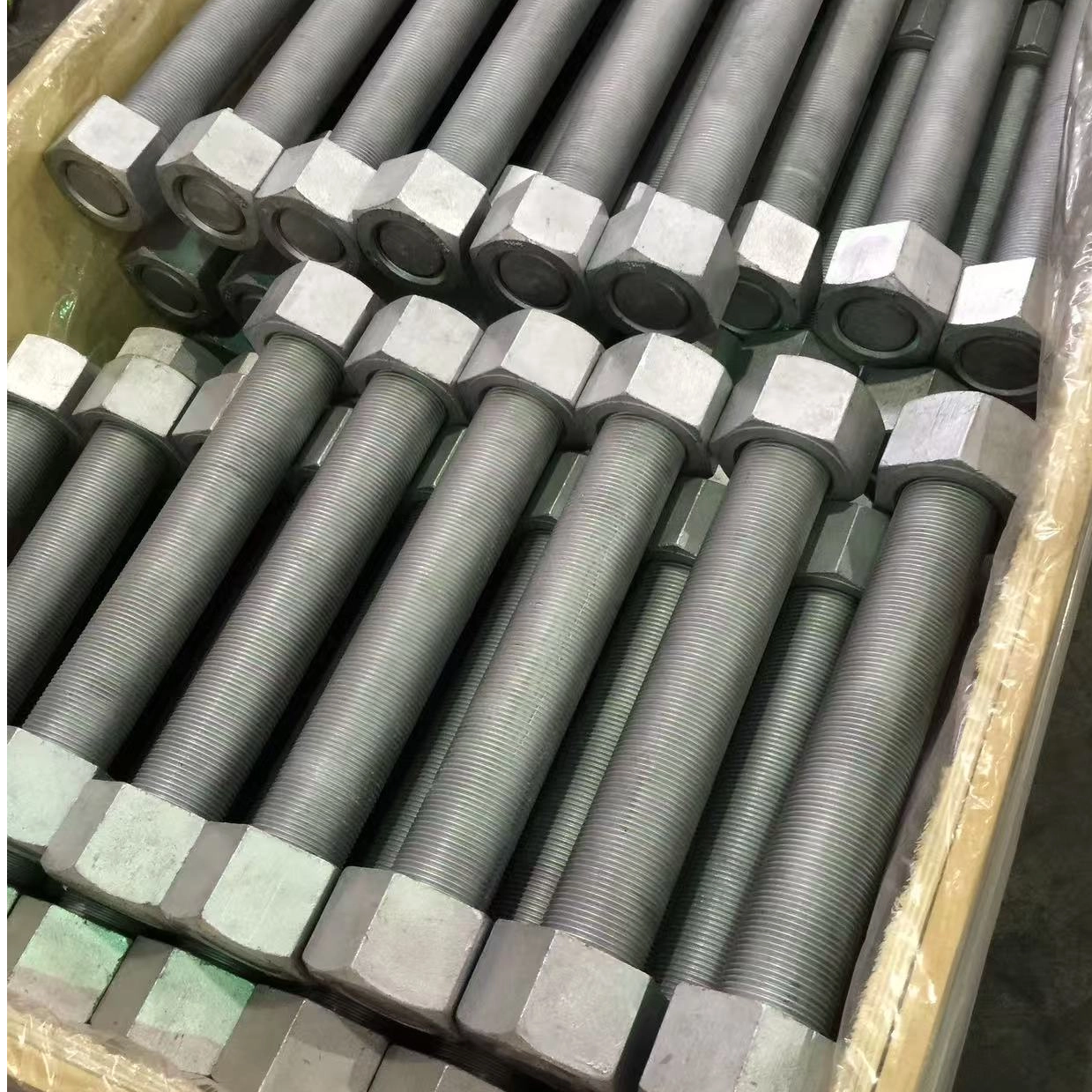
In the production of a high-quality Full Thread Stud Bolt, the threads are never cut using a lathe or die; instead, they are cold-rolled. Thread rolling is a cold forging process where the blank rod is pressed between two hardened steel dies that feature the reverse profile of the desired thread. As the blank rolls between the dies, the material is plastically deformed, displacing the steel to form the peaks and valleys of the thread. This process offers significant advantages over thread cutting. First, thread rolling does not interrupt the natural grain flow of the steel; instead, it compresses and aligns the grain along the contour of the thread, significantly increasing the shear strength and fatigue resistance of the threads. Second, the cold working process induces beneficial compressive residual stresses at the root of the thread, which further inhibits the initiation and propagation of fatigue cracks. Finally, thread rolling produces a highly burnished, smooth surface finish that reduces friction during installation.
Wind turbines are frequently installed in some of the harshest environments on earth, ranging from corrosive offshore marine environments to arid deserts and freezing mountainous regions. Therefore, protecting the fasteners from environmental degradation is paramount. An unprotected steel fastener would rapidly succumb to rust and galvanic corrosion, leading to a catastrophic loss of structural integrity. To prevent this, advanced surface coating technologies are applied. The ideal coating must provide exceptional barrier protection, sacrificial galvanic protection, and maintain a consistent coefficient of friction to ensure accurate tensioning. Because of its critical function, choosing the right surface treatment makes the component the ultimate wind turbine tower fastener for long-term reliability. Common coatings include Zinc Flake coatings (such as Dacromet or Geomet), Hot Dip Galvanizing (HDG), and PTFE (Teflon) coatings. Zinc flake coatings are particularly popular for high-strength fasteners because they provide superior corrosion resistance without the risk of hydrogen embrittlement, a dangerous phenomenon that can occur during the acid pickling and electroplating processes.
The corrosion protection strategy for a Full Thread Stud Bolt must be tailored to the specific environment of the wind farm. For offshore applications, where the fasteners are constantly exposed to salt spray and high humidity, multi-layer coating systems are often employed. These may consist of a zinc-rich base coat for galvanic protection, followed by an epoxy or polyurethane topcoat to provide a physical barrier against moisture and chlorides. The effectiveness of these coatings is rigorously tested using standardized salt spray tests (e.g., ASTM B117), where the fasteners must withstand hundreds or even thousands of hours of continuous exposure without showing signs of red rust. Furthermore, the coating thickness must be carefully controlled; if the coating is too thick, it will interfere with the thread fit, making installation difficult and potentially compromising the clamping force.
The installation of fasteners in a wind turbine tower is a highly technical procedure that requires specialized equipment and trained technicians. Unlike standard construction bolts that are tightened using torque wrenches, the high-strength fasteners used in tower flanges are typically installed using hydraulic tensioning equipment. Hydraulic tensioning involves threading a specialized tensioner onto the protruding end of the fastener above the nut. Hydraulic pressure is then applied, which physically stretches the fastener to a predetermined length. While the fastener is stretched, the nut is easily turned down flush against the flange using a tommy bar. When the hydraulic pressure is released, the fastener attempts to return to its original length, creating a massive, highly accurate clamping force across the flange joint. This method eliminates the inaccuracies associated with friction in torque-based tightening, ensuring that every Full Thread Stud Bolt in the flange is loaded uniformly.
Achieving and maintaining the correct preload in a Full Thread Stud Bolt is the single most important factor in preventing joint failure. If the preload is too low, the dynamic loads from the wind turbine will cause the flange joint to open and close slightly with each rotation of the blades. This micro-movement, known as joint separation, rapidly subjects the fastener to high-amplitude stress cycles, leading to premature fatigue failure. Conversely, if the preload is too high, the fastener may yield or break during installation, or the flange itself may be deformed. Engineers use complex calculations, taking into account the stiffness of the fastener, the stiffness of the clamped parts, and the anticipated external loads, to determine the optimal target preload. During installation, ultrasonic elongation measurement devices are often used to verify that the fastener has been stretched to the exact millimeter required to achieve this target preload.
Given the catastrophic consequences of a tower failure, the quality control processes governing the production of wind turbine fasteners are among the most stringent in the manufacturing industry. Every stage of production, from raw material receipt to final packaging, is subject to rigorous inspection and documentation. Manufacturers must operate under strict quality management systems, such as ISO 9001, and the fasteners themselves must comply with international standards such as ISO 898-1, EN 14399, or specific OEM requirements. Because structural integrity is non-negotiable, every single tower connection bolt undergoes comprehensive testing before it is approved for dispatch. This includes dimensional checks using precision gauges, mechanical testing to verify tensile strength, yield strength, and elongation, and hardness testing to ensure the heat treatment was successful.
In addition to destructive mechanical testing on sample batches, advanced Non-Destructive Testing (NDT) methods are employed to ensure the internal and external integrity of the Full Thread Stud Bolt. Magnetic Particle Inspection (MPI) is widely used to detect surface and slightly subsurface cracks, forging laps, or seams that could act as stress concentrators. For detecting internal flaws such as voids, inclusions, or internal cracks, Ultrasonic Testing (UT) is utilized. High-frequency sound waves are transmitted through the fastener, and the reflected echoes are analyzed to identify any anomalies within the steel matrix. Only fasteners that pass these rigorous NDT inspections are deemed safe for use in wind turbine tower connections, ensuring that no hidden defects compromise the safety of the wind farm.
Wind turbines are designed to harvest energy from the weather, but they must also survive its extremes. Fasteners used in tower connections must be capable of maintaining their mechanical properties across a wide range of temperatures and environmental conditions. In cold climates, standard steel can become brittle and susceptible to sudden impact failure. Therefore, a Full Thread Stud Bolt intended for cold-weather deployment is subjected to Charpy V-notch impact testing at sub-zero temperatures, often down to -40°C or even -50°C, to guarantee that the material retains sufficient fracture toughness to withstand ice loads and freezing winds. Conversely, in hot, desert environments, the fasteners must resist the degrading effects of intense ultraviolet radiation and extreme temperature fluctuations between day and night.
Temperature fluctuations introduce another complex variable: thermal expansion and contraction. As the ambient temperature changes, both the steel tower flanges and the fasteners expand and contract. If the coefficient of thermal expansion of the fastener differs significantly from that of the flange material, temperature changes can cause the clamping force to increase dangerously or decrease to a point where the joint becomes loose. A high-quality Full Thread Stud Bolt is engineered from alloys that closely match the thermal expansion characteristics of the tower steel, ensuring that the critical preload remains stable regardless of whether the turbine is operating in the freezing cold of winter or the blistering heat of summer.
The wind energy industry is continuously evolving, and many early-generation wind farms are now reaching the end of their original design lives. Instead of decommissioning these sites, operators are increasingly opting for repowering—upgrading the turbines with larger rotors and more powerful generators to increase energy output. This repowering process often places higher loads on the existing tower structures. Consequently, upgrading the fastening systems is a critical component of wind farm life extension projects. Replacing older, potentially fatigued fasteners with a modern, high-strength Full Thread Stud Bolt can significantly enhance the structural capacity of the tower, allowing it to safely support the increased loads of the new turbine components.
Throughout the operational life of a wind turbine, the fastening systems require ongoing monitoring and maintenance. Despite the high initial preload, a phenomenon known as relaxation can occur over time. Relaxation is the gradual loss of clamping force due to the embedding of the mating surfaces, the flattening of microscopic surface asperities, and the long-term creep of the materials under high stress. To address this, wind farm maintenance protocols typically require a mandatory inspection and re-tensioning of the tower fasteners after the first few months of operation, and periodically thereafter. Advanced sensor technologies are now being integrated into some fastening systems, allowing operators to remotely monitor the tension of a Full Thread Stud Bolt in real-time, shifting maintenance strategies from scheduled interventions to predictive, condition-based maintenance.
In the demanding and high-stakes environment of wind energy generation, the structural integrity of the turbine tower is paramount. Our Full Thread Stud Bolt solutions are meticulously engineered to provide the ultimate in safety, reliability, and performance for wind turbine tower connections. By choosing our advanced fastening systems, wind farm developers and operators benefit from several critical advantages:
Exceptional Tensile and Yield Strength: Manufactured from premium, ultra-clean alloy steels and subjected to precise heat treatment, our fasteners easily meet and exceed Grade 10.9 and 12.9 requirements, ensuring they can withstand the most extreme aerodynamic and bending loads.
Superior Fatigue Resistance: Utilizing advanced cold thread rolling technology, our fasteners feature an optimized grain structure and beneficial compressive residual stresses, drastically reducing the risk of fatigue failure in high-vibration wind turbine environments.
Advanced Anti-Corrosion Protection: We offer a range of high-performance surface coatings, including state-of-the-art Zinc Flake systems, providing exceptional resistance to salt spray, moisture, and harsh environmental degradation without the risk of hydrogen embrittlement.
Precision Installation Compatibility: The continuous, highly accurate thread profile ensures seamless compatibility with hydraulic tensioning equipment, allowing for exact elongation and the achievement of the perfect clamping force every time.
Rigorous Quality Assurance: Every batch undergoes comprehensive mechanical and non-destructive testing (MPI, UT), guaranteeing zero defects and absolute reliability for the entire 25-year lifespan of your wind energy project.
Investing in our premium Full Thread Stud Bolt technology means investing in the long-term stability, safety, and profitability of your wind energy infrastructure. Engineered for excellence, our fasteners are the definitive choice for securing the future of renewable energy.


