


Selecting the wrong fastener can trigger catastrophic joint failures across your most critical infrastructure. Stripped threads in expensive castings or unexpected maintenance delays quickly cost industrial operations millions of dollars annually. When you operate in high-pressure, high-vibration, or frequent-disassembly environments, simple hardware choices carry massive commercial stakes. Fastener selection demands strict scrutiny. You must move beyond basic tensile strength to carefully evaluate actual clamping force, precise thread engagement, and long-term lifecycle viability. Relying on outdated assumptions often leads to severe mechanical breakdowns. We will provide an objective breakdown of core structural differences, proven engineering advantages, and strict standard compliance. By understanding these mechanical principles, you can empower your procurement and engineering teams to specify the exact right component every time.
A standard bolt relies on an integrated head and single tapped hole, while a stud bolt utilizes two nuts, creating a more even distribution of clamping force.
Stud bolts are the industry standard for high-pressure flanges (ASME/API) and high-performance engine blocks due to superior tensioning capabilities and protection of internal casting threads.
Standard bolts offer faster assembly in low-clearance environments and are highly cost-effective for general structural joints that do not require frequent maintenance.
Proper evaluation requires assessing maintenance frequency, required clamping accuracy, and spatial constraints during assembly and disassembly.
A standard hex bolt features an integrated forged head. It has a single threaded shank extending from this head. Engineers design these for straightforward applications. You apply torque directly to the head during installation. This action transfers rotational friction into the internal threads of the mating material.
This rotational force introduces significant failure point risks. Twisting forces combine with axial tension. We call this combination torsion. Torsion stresses the fastener body heavily. It can weaken the metal during installation. This compromises the final clamping force. Installers must carefully monitor their torque limits. Excessive rotation often leads to sheared heads or stripped internal threads.
Manufacturers design these fasteners differently. They are entirely headless. You will find them threaded on both ends. Some versions feature continuous threads along the entire length. You install them stationary into a casting. Alternatively, you pass them through a clearance hole. You secure them using nuts on one or both ends.
This design offers a massive tensioning advantage. A stud bolt allows for pure axial tensioning. Engineers call this stretch. You apply force only to the nuts. You do not apply twisting friction to the stud itself. This isolates the tension. It prevents torsional stress from damaging the fastener core. The result is a much stronger, more reliable joint.
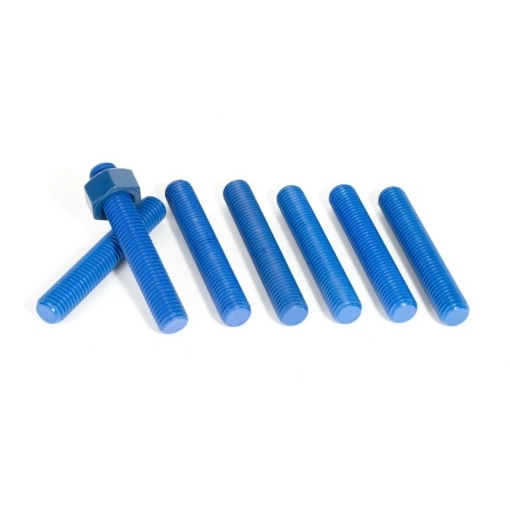
Turning a nut on a stud prevents severe wear on internal threads. This is critical for cast iron or aluminum blocks. Frequent removal of standard bolts degrades soft internal threads. Eventually, these threads strip completely. A stationary stud takes the rotational wear on its external threads instead. You only replace the nut or the stud if wear occurs. You save the expensive engine block or heavy machinery casting from permanent damage.
Industrial piping heavily relies on these headless fasteners. They act as guide pins for heavy flanges and gaskets. ASME B16.5 standards specifically recommend them for piping systems. Installers can slide the heavy flange directly over the protruding studs. This simplifies assembly immensely. It guarantees perfect alignment before you tighten the nuts. This equalizes gasket compression across the entire joint. Poor alignment causes catastrophic leaks in high-pressure lines.
Engineers demand precise clamping forces in critical applications. Studs allow for highly accurate hydraulic tensioning. Hydraulic tools stretch the fastener precisely. You spin the nut down by hand. You release the hydraulic pressure. The stud tries to shrink, clamping the joint perfectly. They do not suffer from the rotational friction losses seen in standard bolts. Therefore, clamping force remains highly predictable. Predictability prevents joint failure under extreme loads.
High-vibration environments destroy weak joints. The lack of a forged head eliminates a common stress riser. A stress riser is a point where structural weakness concentrates. Forged heads often snap under cyclical loading. Headless fasteners distribute stress evenly across their threaded length. This makes them highly resilient in heavy-duty applications. They absorb vibrations without fracturing. You must specify them for compressors, pumps, and heavy engines.
Studs naturally project outward from the mating surface. This projection can block the sliding placement of subsequent parts. Maintenance teams often struggle in tight spaces. You cannot easily maneuver heavy components over protruding threads. Bolts offer a distinct spatial advantage. You can remove them entirely. This allows you to slide mating parts directly into place. Low-clearance environments dictate their use.
Structural steel construction relies on speed. Assemblies that rarely require disassembly benefit from standard fasteners. They offer much faster installation times. You only handle one component and one nut. Sometimes you thread them directly into tapped holes, requiring no nuts at all. You reduce part counts significantly. This accelerates assembly lines and construction schedules. For static joints, they remain the undisputed champion.
Budget constraints often drive engineering decisions. Standard fasteners feature lower upfront manufacturing costs. They are mass-produced efficiently. They simplify your inventory management. You stock fewer nuts and washers. For non-critical applications, they make perfect financial sense. You should never over-engineer a simple joint. Standardized head designs provide immense cost-effectiveness for everyday structural needs.
You must navigate common standard pairings carefully. High temperature and high-pressure environments demand specific alloys. Procurement teams frequently specify ASTM A193 Grade B7 materials. They pair these with A194 Grade 2H nuts. This pairing guarantees structural integrity under thermal expansion. Mixing incompatible grades causes rapid joint failure. You must verify material test reports for every batch. Grade matching prevents catastrophic blowouts in petrochemical applications.
While a stud bolt has a higher initial component cost, the long-term savings are substantial. You must evaluate repair dynamics over time. Using standard bolts in tapped holes often leads to stripped threads. Repairing these requires drilling and installing thread inserts like Heli-Coils. This causes massive equipment downtime. Headless fasteners drastically reduce these repair costs. They protect the primary casting. You only replace the inexpensive fastener, saving days of maintenance labor.
Procurement teams must balance off-the-shelf availability against custom needs. Standard hex bolts meet safety factors for most general applications. They ship quickly and cost less. However, heavy industrial tasks often require application-specific lengths. Hydraulic tensioning tools require extra thread length for tool clearance. You must assess whether standard sizes meet your tensioning requirements. Custom lengths prevent tooling interference during critical assembly phases.
Fastener Evaluation Criteria
Evaluation Criteria | Standard Hex Bolt | Headless Stud |
|---|---|---|
Primary Force Applied | Torsion and Tension | Pure Axial Tension |
Clearance Requirement | Low (Removable) | High (Projects outward) |
Assembly Speed | Fast (Fewer parts) | Slower (Requires two nuts) |
Vibration Resistance | Moderate (Stress at head) | Excellent (No stress risers) |
Casting Protection | Poor (Wears tapped holes) | Excellent (Stationary threads) |
Stainless steel and alloy fasteners are highly susceptible to cold-welding. We call this phenomenon thread galling. It occurs when nuts are driven too quickly. The friction melts the thread surfaces together. You cannot untighten them once galling occurs. You must cut them off. Specific anti-seize lubricants are absolutely mandatory. You must employ strict torque sequencing. Slow, controlled tightening prevents this expensive installation failure.
Double-end studs require careful installation in blind holes. You must seat them to the correct depth. Over-driving them acts like a hydraulic press. It can easily fracture an expensive iron casting. Under-driving them is equally dangerous. It compromises the required thread engagement strength. Installers must use proper depth gauges. You should train your team on seating procedures to avoid cracking major equipment.
Procurement errors happen frequently due to measurement confusion. You must clarify the measurement standards before ordering. Some standards measure first-thread to first-thread. Others measure end-to-end. Mixing these up leaves you with fasteners that are too short for tensioning tools. Always specify the exact measurement method on your purchase orders. Verifying this prevents costly project delays during final assembly.
Default to standard hex fasteners for static, high-clearance structural joints to save on upfront assembly costs.
Upgrade to headless, double-ended components for high-pressure, high-temperature, or maintenance-heavy environments to protect your expensive castings.
Always match material grades strictly according to ASTM standards to prevent thermal or pressure failures.
Mandate anti-seize lubricants and proper seating depths to eliminate galling and casting fractures during installation.
Fastener selection requires input from both mechanical design and supply chain specialists. You should immediately consult with your engineering support team to review your current joint specifications. Ask your supplier for a quote on application-specific fastener grades and advanced anti-galling coatings to secure your next critical project.
A: Strength depends heavily on the specific material grade and alloy. However, headless fasteners provide much more accurate clamping force. They eliminate the forged head, which removes a common stress riser. This geometric advantage gives them significantly better fatigue resistance in high-vibration applications.
A: They act as structural guide pins, making it easier to align heavy flanges. They comply with ASME B16.5 standards. This alignment guarantees equalized gasket compression across the joint. Equal compression prevents dangerous leaks in high-pressure petrochemical and fluid pipelines.
A: It depends on the yield limits. Fasteners torqued past their yield point undergo plastic deformation. You must discard these permanently. Fasteners kept within their elastic limits can often be reused. You must inspect the threads carefully for stretching or galling before any reuse.
A: A fully threaded (continuous) variant has threads across its entire body, making it ideal for mating two flanged joints with nuts on both sides. A double-end variant has an unthreaded middle section. Engineers use double-end versions primarily for bottoming out into blind tapped holes.


