
Views: 0 Author: Site Editor Publish Time: 2026-08-31 Origin: Site


For high-pressure, heavy-duty, or custom flange applications, traditional fasteners often fail to provide uniform tension or straightforward maintenance. You often find standard hex bolts struggling to maintain clamp loads during severe thermal cycling. Industries running critical fluid systems require a more robust, specialized solution. Engineers and procurement managers must constantly balance rigid tensile strength requirements with everyday assembly efficiency. Selecting the wrong fastener easily leads to catastrophic joint failure, severe maintenance downtime, or regulatory compliance breaches. These missteps threaten both onsite safety and overall facility output. This guide breaks down exactly how a double-ended stud functions under extreme stress. We examine the engineering rationale for choosing them over standard alternatives and detail the exact specifications required to make an informed purchasing decision. You will discover actionable insights to optimize your next flange assembly project and ensure long-term mechanical reliability.
Superior Tension Control: Double-ended studs allow for nuts on both ends, enabling highly accurate, symmetrical tensioning in critical flange connections.
Specification-Driven Selection: Sourcing requires strict adherence to standards (e.g., DIN 938 for unequal lengths) and precise metric/imperial tolerances.
Reduced Maintenance Friction: Unlike standard bolts, stud bolts remain stationary during nut removal, minimizing thread wear on expensive tapped housings.
Material Alignment: Matching the stud material (e.g., 304/316 Stainless, specialized coatings) to temperature and pressure environments is non-negotiable for joint integrity.
A Double-ended stud features an unthreaded middle section called the shank. It has threading on both ends. You can attach a nut to each side of the fastener. Alternatively, you can thread one side directly into a tapped machine hole while securing the other end with a nut. The unthreaded shank provides a specific grip length. This grip length allows for better elasticity under heavy loads.
You will encounter three main variations of stud fasteners in heavy engineering. You must understand their physical differences to select the right one for your application:
Full-Thread Studs: These feature continuous threading from end to end. They lack an unthreaded shank. Engineers primarily use them for general-purpose bolting or when they need maximum adjustability.
Tap-End Studs: These have a short thread on one end designed for an interference fit. You drive this short end into a tapped hole permanently. The other end features a standard thread for nut assembly.
Double-End Studs: These have distinct threaded portions on both ends separated by an unthreaded shank. You typically use them in heavy flange connections where you need equal clamping force on both sides.
Standard hex bolts force you to twist the entire fastener during installation. This rotational action causes immense torsional friction. It rapidly wears down the internal threads of a tapped hole. Repeated assembly and disassembly will eventually strip these internal threads. Repairing a stripped housing requires complex machining or expensive inserts.
Studs completely change this dynamic. They isolate the rotational friction directly to the nut. Once you install the stud into a tapped hole, it remains perfectly stationary. You only turn the nut on the exposed end. This mechanical isolation protects the expensive machined components from wear. It significantly extends the lifespan of large castings, engine blocks, and complex valve bodies. You preserve the integrity of your most critical infrastructure.
High-pressure pipelines and pressure vessels demand flawless gasket compression. Uneven compression causes catastrophic leaks. Standard bolts introduce torsional stress into the fastener body as you turn the head. This twisting motion distorts the true clamping force. You get an inaccurate reading on your torque wrench.
Tightening a double-ended stud from both ends yields a remarkably accurate clamping force. You apply nuts to both sides. This configuration allows you to use hydraulic tensioning equipment. Tensioners pull the stud straight up, elongating it without twisting. You then run the nut down perfectly flush. This symmetrical load distribution ensures completely even gasket compression. It is an absolute requirement for high-pressure chemical or steam environments.
Field mechanics face immense challenges when aligning heavy flanges. Lifting massive pipes into position is dangerous and difficult. Standard bolts require perfect alignment before you can push them through the flange holes. A stud bolt simplifies this entirely.
During heavy flange assembly, double-ended studs act as robust pilot guides. You thread the studs into the lower or fixed flange first. Then, you simply lower the mating flange over the protruding studs. They guide the heavy parts into perfect alignment automatically. This method drastically reduces physical strain and speeds up field operations.
The removal process also heavily favors studs. Fasteners in corrosive environments frequently seize up. If a standard bolt seizes, the head often snaps off. You must then carefully drill out the broken shaft from the casting. This takes hours of precise labor. If a nut seizes on a stud, the fix is simple. You just cut off the seized nut or use a stud extractor to back the entire unit out. You avoid drilling into the expensive primary casting entirely.
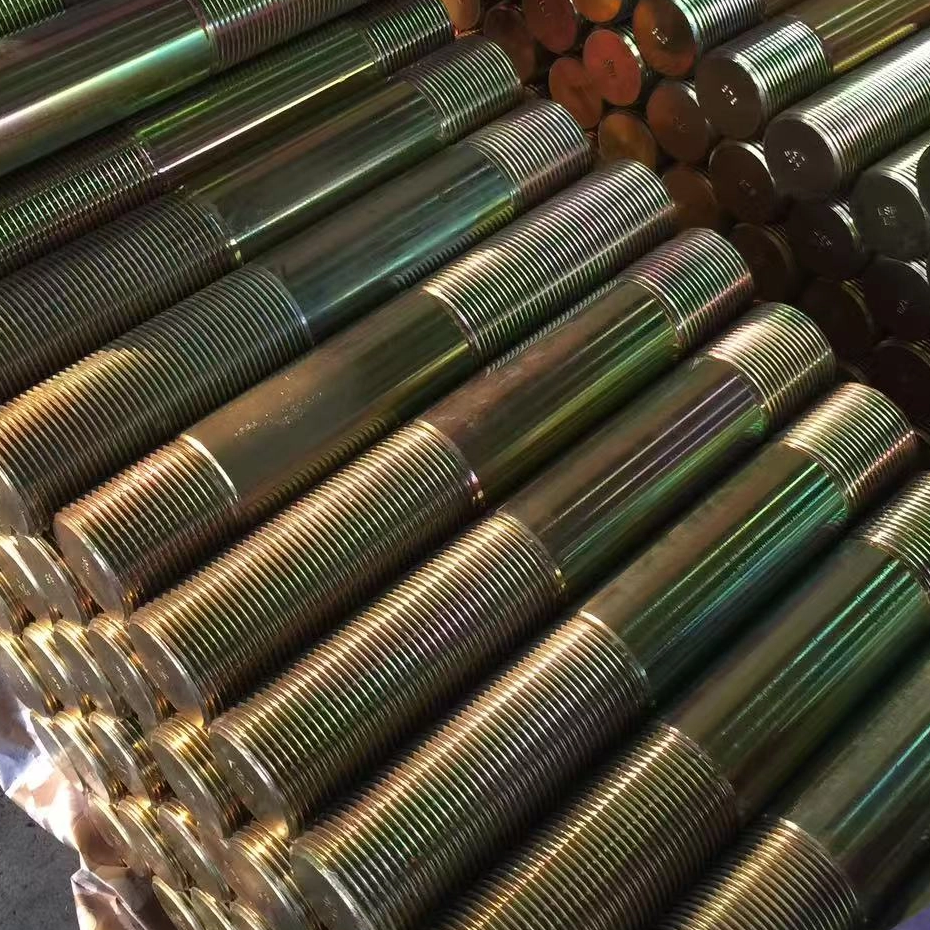
Specifying the right thread configuration ensures joint stability. You must choose between equal and unequal thread lengths. You specify equal threads on both ends when bridging two through-holes. This is common in standard pipe flanges. You specify unequal lengths, often called a tap-end design, when threading into a blind tapped hole. The shorter engagement end often utilizes an interference fit. This fit physically wedges into the tapped hole, preventing the stud from backing out during maintenance.
You also need to apply specific decision logic for thread pitch. Coarse threads possess a larger flank area. They strip less easily and assemble much faster in the field. They also tolerate minor debris and dirt better. Fine threads offer a shallower pitch angle. This geometry naturally resists vibration loosening. You should choose fine threads for high-vibration equipment like reciprocating compressors or heavy engines. They also allow for finer tension adjustments.
Selecting the wrong material guarantees rapid fastener failure. Baseline carbon steel offers excellent tensile strength at a low price. However, it rusts almost immediately in moist environments. You should reserve bare carbon steel for dry, indoor applications or well-lubricated internal engine components.
High-corrosion environments demand superior metallurgy. You must upgrade to 304 or 316 stainless steel for chemical plants or marine settings. The 316 grade contains added molybdenum. This element specifically resists pitting from chloride and saltwater exposure. It provides a massive leap in environmental resilience.
Sometimes, raw material is not enough. You must evaluate specialized coatings and treatments. We outline the most common industrial coatings below to help you match the treatment to your environment.
Material / Coating | Primary Characteristic | Best Application Environment | Key Limitation |
|---|---|---|---|
Carbon Steel (Bare) | High strength, standard yield | Indoor, non-corrosive, internal machinery | Rapid oxidation and rusting |
316 Stainless Steel | High chloride resistance | Marine, chemical processing, food grade | Lower overall yield strength than B7 |
Zinc-Plating (Clear/Yellow) | Sacrificial corrosion protection | General outdoor, moderate moisture | Degrades rapidly in harsh acids or salts |
Hot-Dip Galvanizing (HDG) | Thick, rugged zinc barrier | Heavy structural, offshore, coastal | Requires overtapped nuts due to thickness |
PTFE (Teflon) Coating | Low friction, chemical shield | Petrochemical, highly corrosive offshore | Can be scratched during rough handling |
Global engineering relies on strict standard frameworks. You cannot purchase double-ended studs based solely on visual dimensions. You must source them according to recognized specifications. The DIN (Deutsches Institut für Normung) system is heavily prevalent in metric applications. For instance, DIN 938 dictates exact dimensions for studs featuring an engagement end equal to 1d. This means the threaded portion entering the tapped hole equals one times the nominal diameter of the stud. If you have an M12 stud, the engagement thread is exactly 12mm long. DIN 939 requires a 1.25d engagement, suited for cast iron. DIN 940 requires a 2.5d engagement, ideal for softer aluminum housings.
You must also address metric versus imperial measurement discrepancies. Mixing these systems invites catastrophic failure. A 1/2-13 imperial nut might physically spin onto an M12-1.75 metric stud for a few turns. However, the mismatched pitch tolerances will destroy the threads under load. You must strictly audit global supply chains to prevent cross-contamination of metric and imperial inventory.
You must align your stud grade with the operational limits of your system. ASTM A193 represents the standard specification for alloy steel bolting materials meant for high temperature or high-pressure service. Grade B7 is the undisputed workhorse here. Manufacturers produce B7 studs from chromium-molybdenum steel. They quench and temper the metal to achieve massive tensile strength. B7 studs reliably handle temperatures up to 400°C (752°F). For extreme cold, such as cryogenic LNG facilities, you shift to ASTM A320 Grade L7. This grade undergoes specific Charpy impact testing to ensure it will not shatter at sub-zero temperatures.
Stainless steel double-ended studs face a unique installation risk known as galling. Galling is a form of cold-welding. Stainless steel generates a passive oxide layer to resist corrosion. When you spin a stainless nut onto a stainless stud under pressure, friction strips this protective layer away. The raw metals touch, generate localized heat, and physically weld together. The fastener seizes instantly.
You must employ evidence-based mitigation tactics to prevent this. We recommend the following practices:
Proper Lubrication: Always apply a high-quality, nickel-based or molybdenum disulfide (MoS2) anti-seize compound before threading the nut.
Controlled RPM: Never use high-speed pneumatic impact wrenches to run down stainless nuts. The speed generates too much heat. Turn them slowly by hand or use low-RPM tools.
Dissimilar Alloys: When permissible by design, use different grades of stainless steel for the nut and the stud (e.g., 316 stud with a 304 nut). The differing hardness levels reduce galling risks.
Relying on standard bolt torque charts for stud bolts introduces severe danger. Standard charts account for the friction of turning a bolt head against a flat surface. Stud bolts only involve nut friction. Furthermore, applied coatings like PTFE drastically alter the coefficient of friction. If you apply bare-metal torque values to a PTFE-coated stud, you will stretch the fastener beyond its yield point and snap it.
You must emphasize the need for specific stud tensioning tools. When torqueing is unavoidable, you must use recalculated torque values provided by the coating manufacturer. For highly critical flanges, abandon torqueing entirely. Utilize hydraulic stud tensioners. These tools pull the stud to an exact load specification, eliminating friction variables from the equation.
Supply chain risks can ruin an otherwise perfect engineering plan. You must verify consistent manufacturing quality across large production batches. Machined threads are cut into the metal, severing the natural grain flow. Rolled threads are pressed into the metal, compressing the grain flow. Thread rolling produces a significantly stronger fastener with better fatigue resistance. You must specify rolled threads for heavy-duty applications.
Always demand Mill Test Reports (MTRs) from your vendor. An MTR verifies the exact chemical composition and physical properties of the steel batch. It proves the material meets the ASTM or DIN standards you specified. Without an MTR, you are flying blind and risking catastrophic joint failure.
Selecting the proper fastener requires a methodical, step-by-step approach. You cannot leave flange integrity to chance. Your shortlisting logic should follow a clear path to ensure you cover every mechanical and environmental variable.
Determine the Application: Identify whether you are connecting a standard through-hole flange or driving the fastener into a blind tapped housing.
Calculate Clamping Force: Work with piping engineers to determine the exact tensile load required to compress the gasket without crushing it.
Define Environmental Constraints: Assess the local temperature extremes, chemical exposure, and moisture levels to select the right material grade and coating.
Map to Appropriate Standards: Finalize the exact dimensions and tolerances using established frameworks like DIN 938 or ASTM A193.
Your next steps should involve proactive communication with your supply chain. We encourage buyers to consult their detailed engineering drawings before issuing purchase orders. Request strict MTR documentation from your suppliers upfront. Utilize specialized vendor filtering tools to sort inventory by material grade, specific diameter, and precise thread length. Taking these deliberate actions guarantees you specify exact requirements and secure long-lasting mechanical reliability.
A: A double-ended stud features an unthreaded center shank, known as the grip length. This unthreaded portion adds elasticity, allowing the stud to stretch slightly and maintain tension under pressure. A threaded rod has continuous threading from end to end. The unthreaded shank on a stud provides superior structural stability for high-stress flange applications.
A: Measurement protocols vary by standard. Generally, for DIN standards, you measure the overall length excluding the chamfers (the beveled ends). In many ASME applications, you measure from the first full thread on one end to the first full thread on the opposite end. Always verify the specific standard's measurement rule.
A: Yes. You typically use a tap-end stud for blind holes. The engagement end features a slightly oversized interference thread fit. You drive this end into the tapped hole until it bottoms out or wedges tightly. This fit prevents the stud from backing out when you remove the nut later.
A: Custom studs carry higher upfront tooling costs and longer lead times compared to off-the-shelf sizes. However, utilizing a CNC lathe for non-standard lengths or proprietary thread combinations is highly efficient. The cost becomes negligible when the custom stud prevents leaks in a critical, high-value pressure system.


