
Views: 0 Author: Site Editor Publish Time: 2026-05-12 Origin: Site


Structural failures in mining equipment lead to catastrophic downtime. Often, the root cause traces back to a single, corroded connection point failing under high-vibration stress. Mining environments uniquely punish structural joints. They expose critical assemblies to a destructive combination of heavy impact loads, abrasive dust, extreme moisture, and acidic chemical runoff. Standard fasteners simply cannot survive this harsh matrix. Engineers need a robust, permanent solution. Specifying a hot dip galvanized heavy hex nut for structural assemblies delivers exactly what is required. This specific hardware combines superior load distribution with active electrochemical corrosion defense. It successfully mitigates equipment failure in the toughest global conditions. You will discover exactly how structural geometry pairs closely with metallurgical defense. We will explore the mechanics of cathodic protection. We will also cover specification criteria to ensure your heavy machinery remains operational and safe.
Load Capacity: The increased width and thickness of a heavy hex nut disperse clamping force over a wider area, preventing stress concentration in high-vibration mining machinery.
Electrochemical Defense: Hot dip galvanizing (HDG) creates a 50–100 μm metallurgical bond that acts as a sacrificial anode, offering decades of maintenance-free life in severe industrial environments.
The Bare Thread Paradox: HDG nuts require oversized tapping after coating. Internal threads remain bare but are entirely protected from rust through cathodic protection when mated with an HDG bolt.
Installation Realities: Mixing bare hardware with HDG components causes systemic failure. Genuine HDG heavy nuts must be pre-lubricated to prevent galling (metal-to-metal binding) during assembly.
Standardizing on lower-tier components creates a dangerous illusion of efficiency. Procurement teams often purchase standard-sized nuts or basic zinc-plated hardware. This approach requires frequent bolt replacement. Field technicians must regularly drill out seized nuts. These actions halt production rapidly. Indirect operational losses easily eclipse initial hardware savings.
Heavy machinery experiences brutal kinetic forces. Excavators, crushers, and ventilation systems generate constant micro-movements during operation. Standard nuts lack the required mass. They do not have enough bearing surface to maintain tension over time. This deficiency inevitably leads to continuous back-off. Joint slip becomes a daily hazard.
Corrosive accelerants compound these mechanical challenges significantly. Deep underground tunnels trap moisture indefinitely. Open-pit sites expose steel to severe weather cycles. Acidic mine drainage pools around vital structural joints. These harsh elements quickly chew through standard 5–10 μm zinc plating. Complete rust penetration happens within months.
Here are the primary failure modes you must watch out for:
Vibration-Induced Loosening: Micro-movements degrade the clamp load over time.
Galvanic Attack: Acidic mine water accelerates electron transfer, destroying thin zinc layers.
Shear Stress Failure: Standard bearing surfaces deform under heavy equipment impacts.
Abrasive Stripping: Flying rock and debris physically chip away weak electroplated coatings.
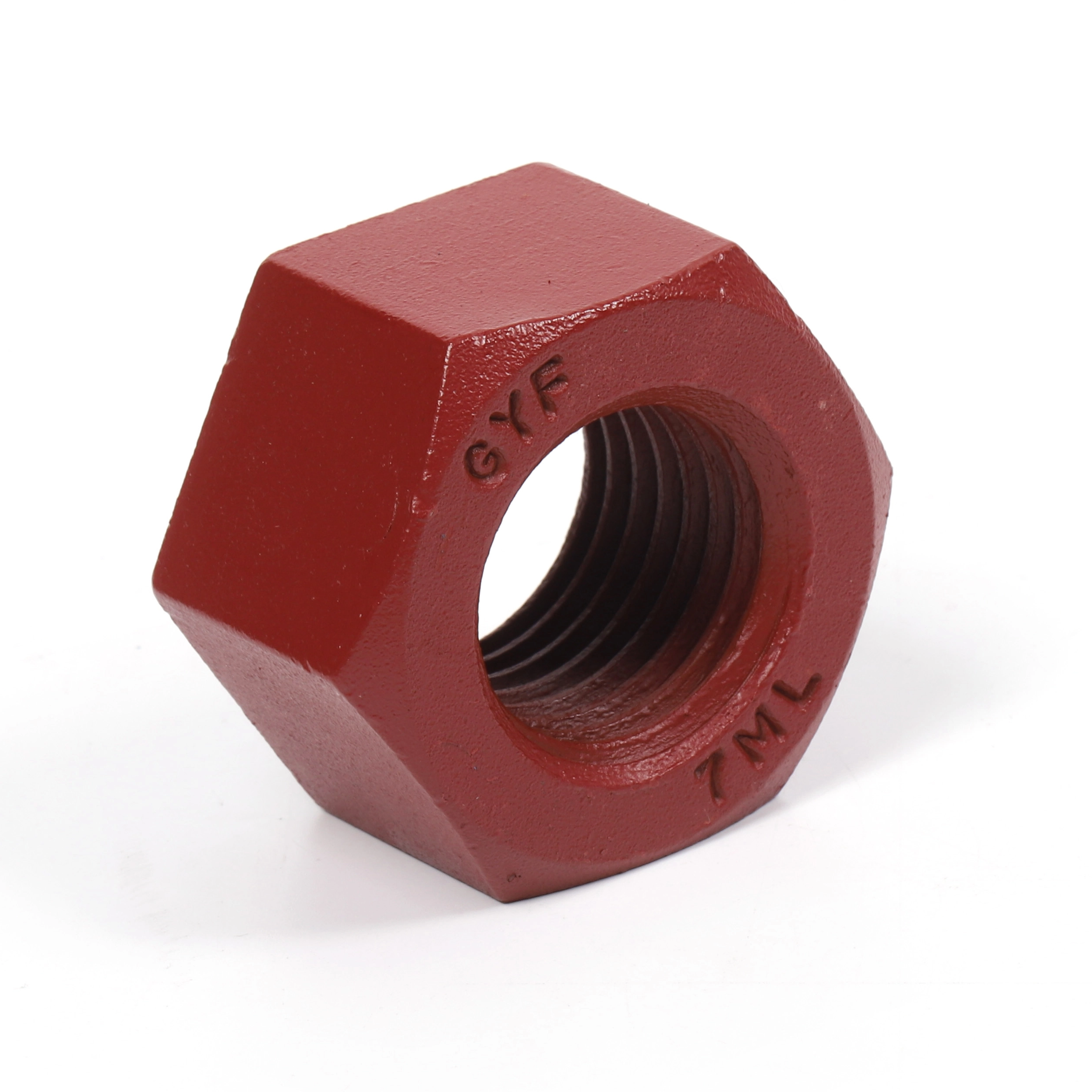
We must marry structural geometry with reliable metallurgical defense. A heavy hex nut provides fractional increases in width across the flats. It also offers increased overall thickness compared to standard nuts. This physical bulk drastically increases the proof load capabilities. It dampens vibration transfer effectively across the entire joint.
The wider stance prevents a dangerous failure mode. It stops the nut from pulling through clearance holes during extreme load shifts. Heavy machinery requires this extra bearing surface. The larger footprint distributes clamping forces evenly. This prevents stress concentrations from cracking the base steel.
Hot dip galvanizing offers a uniquely powerful defense mechanism. Electroplating relies solely on weak mechanical adhesion. Conversely, HDG forms distinct zinc-iron alloy layers. This happens through a thermal reaction at approximately 840°F. The molten zinc physically integrates into the steel surface.
The resulting coating bonds at up to 3600 psi. Interestingly, these inner alloy layers are harder than the base steel. They actively resist physical abrasion from flying rock and debris. Standard coatings scratch away quickly. HDG stands strong against brutal physical impacts.
Procurement teams often express skepticism when inspecting HDG fasteners. They notice visibly bare internal threads on the nut. This observation logically leads to concerns about immediate rusting. People assume bare steel will fail in a wet mine.
Manufacturing realities explain this specific phenomenon clearly. According to ASTM A563 section 4.7.5, HDG adds significant coating thickness. The zinc layer ranges from 0.002 to 0.006 inches. Manufacturers must tap nuts oversized after galvanizing. This allows the bolt to physically thread through the nut. If they plated the internal threads, the assembly would jam immediately.
Cathodic protection prevents these bare threads from corroding. Steel corrodes when acting as an anode in an electrolyte like moisture. Zinc is more electrochemically active than steel. The zinc on the mated bolt sacrifices its own electrons. It protects the bare internal threads of the nut perfectly.
As long as the bolt retains its zinc coating, the internal threads remain completely safe. The galvanic cell works in your favor. You essentially install a tiny, self-sustaining battery. It actively fights off oxidation.
Corrosion Protection Mechanisms Comparison | |||
Coating Type | Bond Type | Average Thickness | Thread Protection Mechanism |
|---|---|---|---|
Standard Zinc Plating | Mechanical | 5–10 μm | Barrier protection only; fails quickly if scratched. |
Hot Dip Galvanizing (HDG) | Metallurgical | 50–100 μm | Cathodic protection; zinc sacrifices electrons for bare steel. |
Bare Carbon Steel | None | 0 μm | No protection; rapid oxidation in damp environments. |
Engineers must standardize procurement across OEM and contractor specifications. Material grades dictate performance in heavy mining equipment. You must match the correct steel chemistry to the application.
You should specify ASTM A563 Grade C or DH for robust applications. These grades provide excellent strength and durability. Conversely, you must avoid specifying HDG for ultra-high-strength components. Grades like A490 or 12.9 equivalents face high risks of hydrogen embrittlement. The acid pickling phase introduces hydrogen into the metal structure. This causes sudden, catastrophic brittle failure under tension.
You must also reassure engineering teams regarding friction in slip-critical connections. Under current AASHTO LRFD standards, HDG friction surfaces perform exceptionally well. They are classified as Class C. This offers a reliable slip coefficient of μ = 0.30. You do not need to perform manual wire-brushing on these surfaces anymore. The natural weathering of the zinc provides adequate grip.
Clearance hole sizing requires careful attention during the design phase.
For bolts 1 inch and larger, standard clearance holes inherently accommodate the HDG coating.
You do not need additional oversized drilling on the structural steel base plates.
For bolts smaller than 1 inch, verify hole tolerances before final assembly to prevent binding.
Always consult the latest AISC manuals for exact dimensional tolerances.
The fastest way to ruin a structural mining connection is poor assembly practice. Site execution matters immensely. Even the best materials fail if workers install them incorrectly. You must educate field crews on proper handling.
You must understand the severe danger of mixing hardware. Never pair a galvanized bolt with a plain steel nut or washer. The bare steel acts as a massive cathode. It will drain the zinc's sacrificial properties rapidly. This initiates severe galvanic corrosion. The entire joint will degrade prematurely, creating extreme safety hazards.
Preventing galling represents another critical requirement. Galling occurs when metals seize and bind together permanently. The textured surface of an HDG layer increases friction during torque application. The rough zinc surfaces lock together aggressively.
Proper specification requires mandated pre-lubrication. HDG nuts must arrive pre-waxed from the manufacturer. They often use a dyed lubricant for easy visual inspection. This ensures smooth assembly. It guarantees accurate torque-tension ratios. Workers will not experience bolts locking up halfway down the thread. If a bolt galls, crews must cut it off with a torch. This wastes time and ruins expensive hardware.
Evaluating suppliers requires looking beyond the basic piece-price. Traceability ensures safety and reliability in massive mining infrastructure. You cannot afford anonymous hardware holding up thousands of tons of steel.
Undocumented fasteners carry severe liability risks. You must demand Material Test Reports (MTRs) for every incoming batch. Ensure your supplier provides complete lot-level traceability. These reports verify proper zinc thickness. They also confirm exact steel grade compliance. A legitimate supplier keeps these records readily available. They should track the heat number from the original steel mill.
Supply chain streamlining also plays a huge role in successful installations. Finding the right hardware onsite takes too much time. Workers digging through unorganized bins causes massive inefficiencies.
Prioritize vendors offering site-specific kitting. They pre-package the exact ratio of HDG bolts, heavy nuts, and compatible washers. This eliminates sorting time in the dirt. It prevents dangerous installation delays in the field. When crews have everything packed together, they build faster. They also make fewer mistakes regarding hardware compatibility.
Upgrading structural hardware is a simple, high-yield engineering decision. It perfectly answers the mechanical need for vibration resistance in heavy machinery. It uniquely addresses the chemical need for longevity in abrasive mining environments. By choosing the right components, you protect critical infrastructure from inevitable decay.
Take these immediate next steps to secure your heavy equipment and structural assets:
Review your current bill of materials for high-risk equipment joints. Identify any standard plated nuts.
Audit existing fastener specs to ensure full alignment with ASTM A563 standards.
Verify pre-lubrication requirements with your suppliers to prevent dangerous galling during installation.
Request updated Material Test Reports on all incoming structural HDG hardware to verify compliance.
A: Yes. HDG nuts are specifically overtapped during manufacturing to accommodate the extra 0.002” – 0.006” thickness of the zinc layer on an HDG bolt. The threading process ensures seamless assembly without stripping the protective coating.
A: While stainless steel offers excellent chemical resistance, it generally lacks the high tensile strength of carbon steel equivalents used in heavy structural joints. HDG high-strength carbon steel is typically the safer, more robust choice for load-bearing mining applications.
A: No. The galvanizing process operates at temperatures well below the tempering temperature of standard structural grades (like A325/8.8). This ensures the mechanical properties and hardness of the nut remain completely intact.
A: Depending on the exact atmospheric conditions, including acidity, moisture, and mechanical wear, a 50-100 μm HDG coating routinely provides 20 to 50+ years of maintenance-free corrosion protection.


