
Views: 0 Author: Site Editor Publish Time: 2026-05-20 Origin: Site


Offshore oil platforms operate in some of the world's harshest environments. Structural supports, subsea piping systems, pressure vessels, valve assemblies, and production equipment are continuously exposed to salt spray, humidity, vibration, cyclic loading, and corrosive process media. A fastening system is only as reliable as its weakest component. Selecting the wrong nut can result in preload loss, leakage, costly downtime, or even catastrophic equipment failure.
For engineers, EPC contractors, and procurement professionals, choosing ASTM A194 Grade 7, Grade 7L, and Grade 7M heavy hex nuts is often the preferred solution for demanding offshore applications. These high-strength alloy steel nuts provide the mechanical performance required for critical bolted joints while allowing specialized protective coatings such as Xylan® and PTFE to deliver long-term corrosion resistance. This guide explains how these heavy hex nuts improve reliability, reduce maintenance costs, and enhance safety throughout offshore oil and gas operations.
Engineered for Offshore Service: ASTM A194 Grade 7, Grade 7L, and Grade 7M heavy hex nuts provide the strength and toughness required for offshore oil platforms, subsea piping systems, and pressure-containing equipment.
Corrosion Protection Requires Coatings: Unlike stainless steel fasteners, Grade 7-series alloy steel nuts typically require protective coatings. Xylan® (PTFE) and fluoropolymer coating systems are widely used to improve corrosion resistance and reduce maintenance requirements.
Low-Temperature Reliability: Grade 7L and Grade 7M offer enhanced impact toughness for cold-service environments commonly encountered in offshore oil and gas operations.
Installation and Traceability Matter: Proper lubrication, calibrated torque application, certified coatings, and full ASTM traceability are essential for maintaining long-term joint integrity.
Pipeline supports experience extreme compounding forces around the clock. Thermal expansion causes massive steel structures to shift. Internal pressure fluctuations create unpredictable pipe movements. Extreme shear and tensile loads constantly test the physical limits of every connected joint. These forces never act in isolation. They combine to push mechanical components past their natural yield points.
Standard hex nuts quickly fail under these aggressive conditions. When you use under-specified hardware, a dangerous cascade effect begins. First, inadequate clamping force allows micro-vibrations to loosen the joint. These micro-vibrations lead to fatigue shedding. Over time, the internal threads begin to deform and strip away. This degradation ultimately causes complete joint or flange separation. A single failed connection can shut down an entire processing sector.
Procurement teams must redefine their success criteria for pipeline materials. A bill of materials (BoM) decision must prioritize components retaining continuous clamp loads. Fasteners must actively resist environmental degradation over a multi-decade lifespan. Using a heavy hex nut provides this necessary mechanical baseline. Hardware selection directly dictates infrastructure safety and operational continuity.
Comparing physical dimensions reveals significant engineering differences between nut types. The ASME B18.2.2 standard dictates these precise measurements. A heavy version features a noticeably wider across-flats (WAF) dimension. It also maintains increased thickness compared to standard alternatives. These extra millimeters of steel transform the component's load-bearing capabilities.
Physical traits directly drive mechanical outcomes. Increased thickness translates into greater thread engagement. The wider WAF creates a significantly larger bearing surface area. This expanded surface distributes applied stress much more evenly against the pipeline support or flange. You avoid concentrating destructive forces onto a tiny surface area.
This even stress distribution delivers tangible commercial value. It prevents localized material yielding around the bolt hole. You effectively reduce potential failure points across the entire pipeline network. Securing joint integrity against sudden pressure spikes becomes much easier. Facilities minimize unplanned downtime and avoid disastrous blowout scenarios.
Feature | Standard Hex Nut | Heavy Hex Nut |
|---|---|---|
Width Across Flats (WAF) | Narrower profile | Wider profile (roughly 1/8" larger) |
Overall Thickness | Standard gauge | Increased height for more thread engagement |
Bearing Surface Area | Smaller footprint | Maximized surface area |
Load Distribution | Concentrated stress points | Evenly distributed clamping force |
Ideal O&G Application | Light structural mounts | High-pressure flanges and pipeline supports |
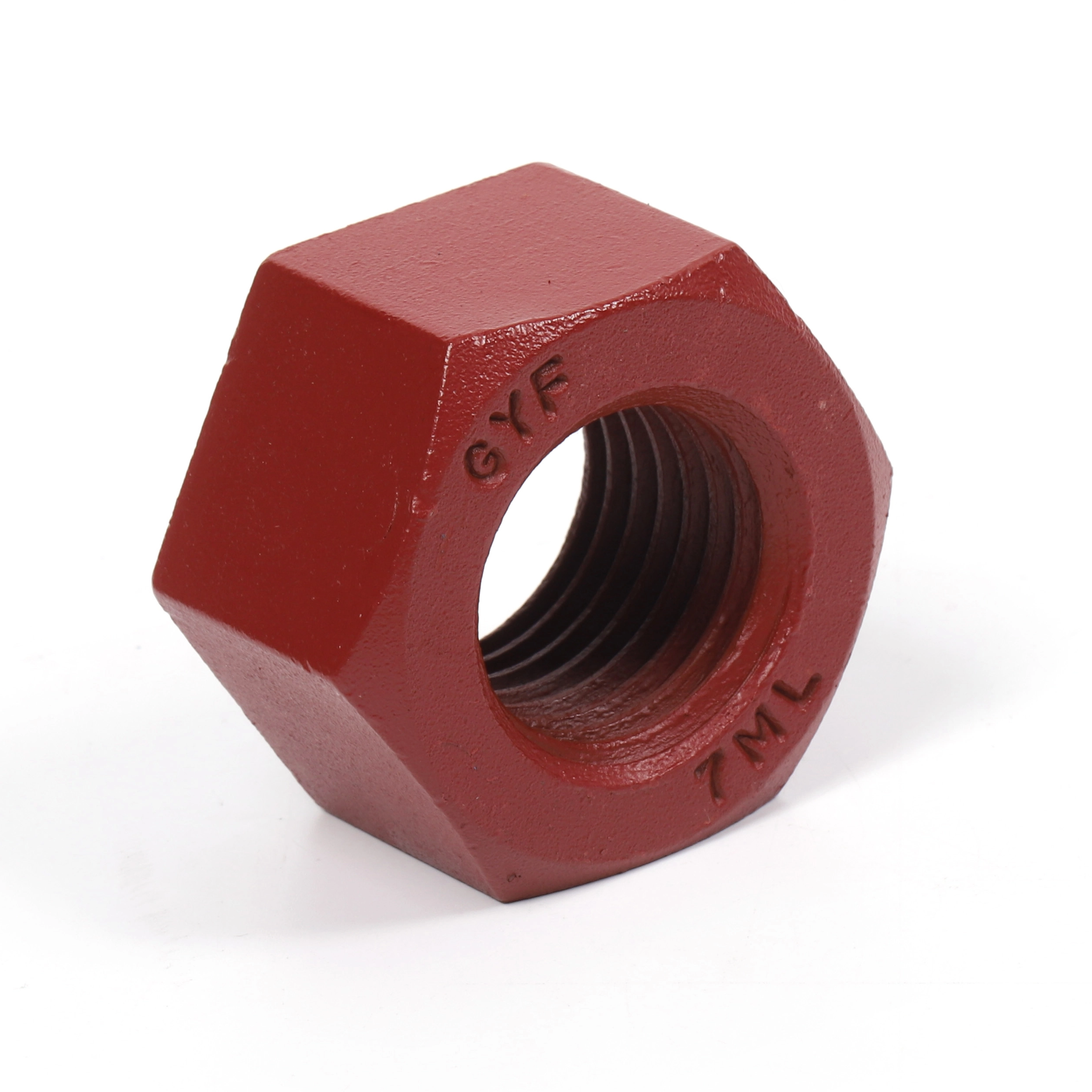
Offshore oil platforms expose fastening systems to some of the harshest operating conditions in the industrial world. Saltwater spray, chloride contamination, cyclic loading, and pressure fluctuations continuously attack structural joints.
ASTM A194 Grade 7, Grade 7L, and Grade 7M heavy hex nuts are widely specified for these demanding applications.
Grade 7 heavy hex nuts are manufactured from alloy steel and heat-treated to achieve high strength and reliable mechanical performance. They are commonly used with ASTM A193 Grade B7 stud bolts in offshore piping systems, pressure vessels, valves, and flange assemblies.
Grade 7L is specifically designed for low-temperature service. The material undergoes additional impact testing requirements to ensure adequate toughness in cold environments. Offshore facilities operating in northern climates frequently specify Grade 7L for critical bolted connections.
Grade 7M offers controlled hardness requirements and enhanced resistance to sulfide stress cracking. It is commonly selected for sour service environments where hydrogen sulfide (H₂S) exposure creates additional material performance challenges.
These grades provide excellent mechanical strength but do not possess the inherent corrosion resistance of stainless steel. Therefore, protective coating systems are typically required for offshore service.
Although ASTM A194 Grade 7, 7L, and 7M heavy hex nuts provide exceptional mechanical strength, offshore environments require additional corrosion protection.
For this reason, fluoropolymer coating systems such as Xylan® and PTFE are widely applied throughout the oil and gas industry.
Xylan® coatings create a protective barrier between the alloy steel substrate and the surrounding marine environment. This significantly reduces corrosion caused by salt spray, humidity, and offshore weather exposure.
PTFE-based coatings lower the coefficient of friction during installation. More consistent torque values can be achieved, improving preload accuracy and reducing installation variability.
The lubricating characteristics of fluoropolymer coatings help prevent thread damage during assembly and disassembly operations.
Coated fasteners typically exhibit longer service life than uncoated alloy steel components, reducing inspection frequency and replacement costs for offshore operators.
For offshore platforms, subsea piping systems, and topside processing equipment, Xylan-coated ASTM A194 Grade 7, 7L, and 7M heavy hex nuts have become an industry-standard solution.
Different sectors within the offshore oil and gas industry require highly specialized fastening solutions. Matching the correct heavy hex nut grade to the operating environment helps maintain preload, improve reliability, and extend service life.
Pipeline flange connections represent some of the most critical pressure-containing joints on offshore platforms. ASTM A194 Grade 7 heavy hex nuts are commonly paired with ASTM A193 Grade B7 stud bolts to achieve reliable sealing performance in accordance with API and ASME requirements.
Offshore drilling platforms face constant exposure to saltwater spray, high humidity, and severe vibration. Xylan-coated ASTM A194 Grade 7 heavy hex nuts provide the combination of strength and corrosion protection required for these demanding conditions.
Heat exchangers, separators, pressure vessels, and process piping systems experience significant thermal expansion and contraction. Properly coated heat-treated alloy steel heavy hex nuts maintain reliable clamping force and reduce preload loss during temperature cycling.
Infrastructure Segment | Primary Challenge | Recommended Grade |
|---|---|---|
Offshore Platforms | Salt spray and vibration | ASTM A194 Grade 7 with Xylan Coating |
Offshore Piping Systems | Corrosion and pressure cycling | ASTM A194 Grade 7 |
Low-Temperature Offshore Facilities | Impact toughness requirements | ASTM A194 Grade 7L |
Sour Service Equipment | Sulfide stress cracking | ASTM A194 Grade 7M |
Pressure Vessels and Valves | High preload retention | ASTM A194 Grade 7 |
Even the highest-quality hardware can fail if installed incorrectly. For ASTM A194 Grade 7-series heavy hex nuts, common installation risks include coating damage, inconsistent torque application, thread damage, and inadequate lubrication.
Following strict installation procedures significantly improves joint reliability.
Apply Proper Lubrication: Use approved anti-seize compounds compatible with Xylan® or PTFE-coated fasteners.
Control Installation Speed: Avoid excessive installation speeds that may damage protective coatings or create inconsistent preload.
Utilize Calibrated Torque: Follow project-specific torque requirements and utilize calibrated equipment to ensure accurate preload.
Verify Clamping Force: Conduct preload verification where required to confirm long-term joint integrity.
Securing offshore oil and gas infrastructure requires uncompromising engineering discipline. ASTM A194 Grade 7, Grade 7L, and Grade 7M heavy hex nuts provide the strength, toughness, and reliability required for critical offshore applications.
Because these alloy steel nuts do not possess the inherent corrosion resistance of stainless steel, protective coating systems such as Xylan® and PTFE are frequently applied to improve performance in marine environments. When properly specified and installed, coated ASTM A194 Grade 7-series heavy hex nuts help protect offshore platforms, subsea piping systems, pressure vessels, valves, and structural supports from premature failure.
Engineers and procurement teams should carefully match ASTM A194 Grade 7, Grade 7L, or Grade 7M nuts with compatible ASTM A193 Grade B7 or B7M stud bolts according to project requirements, environmental conditions, and service classifications. Proper specification today helps prevent costly failures tomorrow.
A: ASTM A194 Grade 7 is the standard high-strength alloy steel grade used for offshore piping, valves, and pressure-containing equipment. Grade 7L is designed for low-temperature service and offers enhanced impact toughness. Grade 7M features controlled hardness requirements and is commonly specified for sour service applications where sulfide stress cracking resistance is important.
Q: Why are Xylan-coated heavy hex nuts commonly used on offshore oil platforms?
A: Xylan® coatings create a protective barrier against salt spray, humidity, and marine corrosion. They also reduce friction during installation, improve preload consistency, and help extend service life.
Q: Which stud bolts are commonly paired with ASTM A194 Grade 7 heavy hex nuts?
A: ASTM A193 Grade B7 stud bolts are the most common mating fasteners for ASTM A194 Grade 7 heavy hex nuts. In specialized applications, ASTM A193 Grade B7M stud bolts may also be specified.
Q: Are ASTM A194 Grade 7-series nuts suitable for offshore environments without coatings?
A: In most offshore applications, protective coatings such as Xylan® or PTFE are strongly recommended because Grade 7-series nuts are alloy steel products and require additional corrosion protection in marine environments.


